Showing posts with label staple-food. Show all posts

18 Aug 2015

Dairy Malaise

Not only are we talking dairy malaise but also a general malaise that has 'egg-xacerbated' the whole farming industry worldwide for years. It is just that dairy price wars have featured on the French and British news lately, and pork price wars are doing the headlines right now. Yet to begin with, we do not need to look further than the antagonistic words 'farming' and 'industry' forcefully sitting next to each other as in 'farming industry', in order to understand the roots of the malaise. And there is no word - nor book title - more eloquent than CIWF's Farmageddon, to sum up the disastrous consequences that a drive for cheap brings.

The Honest Farm Toy by CIWF
Farming was once a history of small family-run concerns and pastoral endeavours that helped families sustain themselves, look after the countryside, build closely-knit communities, be self-sufficient and economically-independent, albeit modestly. The Industrial Revolution lured millions of rural families to the city lights that engulfed them into the darkness of coal mines and textile mills. From the 1920s onwards, farming increasingly became mechanised, and as such, less labour intensive. After World War II, it shifted to a lean, automated, extensive and intensive (monoculture-based), chemically-pumped, figure-churning, competitive industrial model set to satisfy corporate demands for their ever-increasing profit margins at the expense of farmer and flock. This has been amplified since as farming is currently being forcefully channelled into the global one-size-fits-all model. Except that one size fits not.

"Animal and crop rearing were once a happy partnership. Industrialisation divorced them." - Philip Lymbery, Farmageddon

As faceless as industrial models are, the first thing that happened to farming was a faceless revolution in the 1960s as flocks, herds and cattle were moved en masse from their lush pastures to concrete pens tucked away from sunlight and our sight, into barren sheds and hangars. Away from sight means away from the mind of the modern consumer, who associates their pack of sliced ham to a sandwich rather than to the pig it belonged to. And animals in their millions to be farmed for slaughter yearly (currently 70 billion worldwide) have become just that: an obscene number that defies the human mind capacity to fathom them as a collective of individual animals. The number appears as a desensitised distant emotionless global mass instead. Faceless in the hangars and faceless on the mind. Faceless on paper too as numbers are being tweaked and crunched to squeeze productivity out of farm animals to exhaustion, before they end up on the abattoir's conveyor belt on their way out of a short, brutal, confined, loveless - and ultimately pointless - existence.

(Available to purchase via Amazon)
Industrial farming means a serving of pain on your plate, and cheap animal produce (dairy, eggs, meat) is an additional serving of hurt. Now you may think I'm serving you the obligatory activist spiel as a vegetarian, but don't forget that I was once an omnivore, and pretty much oblivious to the fact that the whole farm-to-fork line is nothing more than a series of productivity processes that use and abuse animals to death. I am not seeking to discourage anyone from a meat-based diet, I just want to set the record straight so you get the facts in order to make up your mind for yourself.

I was brought up on a meat diet by meat-loving parents born in the 1940s who underwent full-on the changing consumer habits of the post-war Western world with all the false truths that went along, and for whom a meat-based regimen was (is) a sign of healthy living, social success and a status symbol. To be honest, I never was that much of a meat lover, but peer pressure and preconceptions meant I didn't question my own carnivore habits until only a few years ago.

A lonely calf peeping out of a veal crate... Photography by Jo-Anne McArthur, from her book We, Animals

Just to show you how out of touch with the reality of farming I was, I used to believe (well into adulthood) that dairy cows just so happened to naturally produce milk, without any intervention! The stark reality of dairy farming is that cows are perpetually made pregnant (by natural means or artificially inseminated), then separated from their calves at birth (sending their maternal instinct into disarray) or a few days later, and their milk - that should be feeding their young - is pumped away from them in order to feed us, humans. To the strain of repeated pregnancies, you add the trauma of a mother's separation from her baby, plus the painful milking process, and a life behind bars that ends up in the slaughterhouse, to realise that dairy is dreary!

As multinationals are forcing down produce prices and controlling the commodities market, animals (the very commodities at the heart of the farming industry) are forced to produce more, while their living conditions deteriorate further. And if farmers refuse to comply with the demands or refuse to bow to the pressure of turning their middle-size dairy farm into a super-farm, they lose their concerns to the banks, and the multinationals move on to source out cheaper milk from countries like Germany, Serbia or Poland, where cows have a tougher life. Farmers are as much victims as their animals here. They live from hand to mouth, work extremely long hours for a pitiful wage. Pushed to the end of their tethers by those unscrupulous men in suits, they resort to suicide (one suicide every other day in France). Now pause for a minute and consider the irony of it all: those (animals and farmers) who feed us are the ones who starve and suffer!

La Ferme des Mille Vaches (1000 Dairy Cow Farm) is France's first ever US-style mega-dairy farm, est. 2014.

My purpose is not to condone veg(etari)an practice at the expense of another, or sound like the newscaster of doom and gloom at every article I write. La Baguette Magique being about Lifestyle with Attitude, I am not going to follow the herds down the well-trodden middle of the consumerist road to ukulele you a song about Happy Meals! Instead we'll take one step back in order to get a clearer vision and stay ahead. My purpose is to raise awareness and then leave it up to you, dear readers, to think it over, investigate the issue further if it resonates with you, and decide - or not - to review your consumption habits. Let us bear in mind though that only collectively through our changing consumer habits will we be able to impact the faceless powers that are ruling our food shelves and ruining our food chain. Will you take that stance with me?

P.S: Be sure to watch CIWF's Farmaggedon - The True Cost of Cheap Meat. On a happier note, watch Karma the cow being finally reunited with her calf at The Gentle Barn sanctuary, after a life of misery. Who said cows have no feelings? Therefore no matter how well looked after dairy cows may be at David Homer's farm, they will still be missing their babies...

Further Reading:

[25-Sept-2017 Update]: For a quick and snappy visual idea of the cruelty of the dairy industry, please watch this French documentary preview, showing a cow and her calf who she had given birth to only a few hours prior. The farmer unceremoniously takes her calf away in his van while the mama runs after the vehicle in desperation for her baby! The calf is taken into a hangar where (if a male) he will be fattened up for the veal industry, or (if a female) fattened up to become a dairy cow. A dairy cow will be expected to produce milk for 5-6 years before being slaughtered for meat.
 

21 May 2015

The Artichoke Season - Easy Peasy Kitchen Squeezy!

I have a thing or two for artichokes. They have always fascinated me, as early as my childhood days when I first got acquainted to them through my mum. It is a multi-layered fascination, starting off with their somewhat grandiloquent appellation itself that sounds like 'a choking Archibald' - a mouthful of a word that is more than we can chew, since in all honesty there isn't that much to eat out of an artichoke. You'll have to excuse it but it is a delicacy, and the description befits how it should be treated, daintily like asparagus or wild girolles. Thus if famished you are, and stodge you need, and starch you seek, better make a beeline for a pound of spuds than a heap of 'chokes!


Let's get our facts right. Artichokes are no vegetables. They are in fact an edible budding inflorescence (flower buds). In effect, what we eat is no leaves but petals, plus the base. And this is how far consumption goes, because natural wastage is to be expected from the 'choke.

Artichokes belong to the cardoon family, which incorporates their remote cousin the thistle. They originated in the Mediterranean regions and became domesticated in ancient times, and by the Middle Ages were known to grace gardens across Europe, alongside angelica, chard, boragio, herbs, cress, cabbage, parsnip, turnip, juniper, oats, beans et al - and not a single potato in sight back then! And grace is the word because artichokes add great decorative value to a garden, and I have even seen stalks of them used as part of sculptural floral displays in hotel lobbies and exhibition halls, to great effect!


I love the way artichokes perplex those who are not familiar with them. Yet perplexity shouldn't deter you from experimenting in the kitchen with this great ingredient. As a basic rule, you should go for one big artichoke (or two smaller ones) per person. The sauce that accompanies the artichokes and the temptation of bread to mop it - with fresh baguette slices a must - will sate you. As a personal preference, I find the smaller artichokes easier to deal with in terms of cooking time, taste and tenderness, than the globe artichokes. All the ones pictured here are of the purple medium-sized "Violet de Provence" variety (from my parents' Corsican garden and elsewhere in Corsica).

Artichokes Served with a Mild Mustard Sauce

Artichokes are not fiddly. If you still feel daunted, just follow my easy step-by-step recipe for a basic boiled artichoke served with a no-frills mild mustard sauce.

Bring a large kettleful of water to the boil. Meanwhile shorten the artichoke stalks with a kitchen knife, if necessary (to no shorter than an inch from the base). Rinse off the artichokes, place them in a big saucepan where they will be able to 'swim' about (as per above picture), and add a splosh of cider vinegar to kill off any bug or slug that might linger, and to prevent discolouration from the cooking process. Pour boiling water all over the artichokes. Put on the stove and return to the boil. When the water starts bubbling away, turn down to medium heat and cover the pan. Leave to a soft boil for approx. 20 mins (globe artichokes will take a good 5 mins longer). The best way to find out if the artichokes are cooked is to stick a small peeling knife into the length of the stalk. If the stalk is still hard, leave to cook a few more minutes. Drain the pan and serve the artichokes. Keep additional artichokes in the pan with the lid on until ready to be eaten.


Serve with a ramekin of Mild Mustard Sauce, only two ingredients: pure virgin olive oil and mild mustard! Add as much virgin olive oil as mild mustard to ramekins (one per person) and stir with a teaspoon (or small whisk) until both mustard and oil have creamed into an emulsion. If using stronger mustard, move to a 3 to 1 ratio.

How to Eat: Discard the outer leaves at the base of the stem which naturally tend to remain hard. Then detach one leaf at a time, plunge its fleshy root tip (pulp) into the sauce and insert halfway between the front upper and lower teeth. Then gently close the teeth onto the leaf and pull it off gently, scraping the artichoke matter off the leaf. Discard the rest of the leaf. As you work your way through the artichoke, things will get easier, as the leaves get thinner and melt in the mouth. This is where they are at their tastiest! You can end up actually eating most of the leaves as you get closer to the heart.

When you are left with the peduncle (stem and flower base), scrape off any of the downy matter if any (prevalent in globe artichokes mostly). Roughly slice the peduncle and toss in the sauce. Enjoy the tasty finale!

22 Nov 2013

We Can Make it Possible - Together

Look what I proudly got through my email a few moments ago: my Donation Certificate from Animals Australia, via their Make It Possible website, where I pledged to make a world without factory farming a reality, by personally choosing to 'Be meat-free'! Alternatively you may select to 'Refuse factory-farmed', 'Eat fewer animal products' or 'Make a Cash Donation'.

I'm actually a seasoned vegetarian but I do pledge to remain so until I die - not planning to be one of those 'trendy' volatile veggies that don't eat meat when it suits them and then throw caution to the wind at the sight of vol-au-vents at a buffet, grandma's clam chowder, the office Xmas party or that hasty Friday night shop that involves a basketful of meat-laden convenience food - cos well, them ready meals are so... convenient!


The short 'Make it Possible' documentary (also available via YouTube) came out about a year ago but is still as relevant as ever! It makes for compelling viewing about the cruelty behind the closed doors of factory farming, where animals are born to suffer a life of utter misery, pain, imprisonment, crowdedness and lack of human compassion before being slaughtered to finally end up nicely packaged up on supermarket shelves or on our dinner plates with all the trimmings. Animals are not treated as living creatures which feel pain and emotion. They are punished for a crime they didn't commit. They are treated as mere commodities, objects whose only purpose is to feed us. On earth, the current ratio of factory farmed animals per human is 10 to 1. That makes sweeping the issue of factory farming under the carpet a tad cumbersome, doesn't it?

If you already are a veggie - and you feel I'm preaching to the converted - please bear in mind that the battle isn't won yet. We need to spread the word and share films like this one. If you are a die-hard carnivore, surely the video cannot leave you unmoved at some point. Yet if you read this blog, you will have the level of consciousness that will allow you to be open to question and reconsider your views and habits. Then how about starting off gently with the Meat-Free Mondays? Or start cutting down on some types of meat, like burgers? For the more daring of us, how about opting for a vegetarian Thanksgiving and/ or Christmas? That might sound controversial, but eh you might surprise yourself and convert one or two more guys in the process! At least this will make it one season to remember!

20 Feb 2012

February 2012 - Five Random Faves (Part 4)

Fave #4: Get one step closer to vegetarianism with Meat Free Monday!


Carnivorous friends, if the road to veggie is paved with good intentions that you feel unattainable, how about start off the week with a neat little compromise like going meat-free for the day? Monday is ideal as a good detox day after the week-end's excesses, and one day can't be that harsh a start surely, even if you are a die-hard meat eater!

And even less so when you know that not only will you be doing your health a favour while giving animal life a break, but also helping the planet at large? And you will be carrying out your one-day diet in stellar surroundings (or did I mean 'Stella', as in Stella McCartney?).

According to Meat Free Monday, 'The estimated 634 gallons of fresh water required to produce one 5.2 ounce (147g) beef burger would be enough for a four-hour shower. For comparision, the same quantity of tofu requires 143 gallons of water to produce.' Check MFM for more fascinating facts, as well as for mouth-watering recipes.

To La Baguette it pays off to be a round-the-year veggie, but it certainly is one step in the right direction for any of our meat-loving friends to give one day a week an animal miss! (to be continued)

Ready to commit further?

22 Apr 2011

On and Off the Magic Milky Way (Part 2)

Within the wider dairy produce arena, I was also a Rachel's Organic and Yeo Valley Organic customer (two well-established UK organic dairy brands fondly remembered for their creamy yoghurts and scrumptious yet simple desserts. Obviously if I were still living in England right this moment, I wouldn't put the sentences in the past like this just isn't true anymore. If still in England I would indeed still purchase those brands as I am totally sold to their ethics, philosophy and quality produce.


Back to our UK years, if no organic milk was available from the store, I would reluctantly relent to the mass-produced non-organic standard alternative, and would (more happily) compromise with a couple of tins of Carnation milk, as the processed (evaporated) milk somewhat tastes nicer than standard milk, it tastes like caramel to me. What I would do with Carnation was cut it with a third water, before heating up in a pan for my daily breakfast muesli (Alpen, occasionally Dorset Cereals and even posher ones if I felt flush, or simply stick to Sainsbury's own continental style which was decent enough).

So yes, I consumed my muesli in a very continental way, blended with chocolate-flavoured hot milk (although this might just be my version of continental, I'm not quite sure, just that I can't stand the taste of milk on its own, and simply abhor cold milk - and yes I am daring to dedicate an article to milk while cultivating so many particularities about it!). The girl is strange.

Dairy high: Victoria Sandwich
With Carnation evaporated milk and its caramel undertones, the issue of cow welfare would be sneakily shifted to the back of my mind, to the back burner. Cow welfare? What is that strange girl on about? Oh yes, in the context of industrial farming, when you taste that mass-produced standard milk whose carton price has been squeezed even tighter by the notorious supermarket purchasing lobbies at the expense of the producer's profit margins and subsistence, and to give the end-consumer that elusive feeling that they are making a bargain while the one winner really is the retail chain, the dairy producer has no other option than turn to even cheaper feed for his cows and inflict more crammed living conditions onto them, while increasing his milk quotas, and that means demanding an even higher return on investment from the herd. Therefore expect a higher, faster, more intensive milk turnover with all the consequences that go along. Some French dairy producers push the boat even further by moving their production altogether to cheaper countries like Romania, spelling an even harsher life for the cows.

The objective is for the dairy cow to produce more milk and be milked round-the-clock to exhaustion, until both the milk and the animal's life have drained out! This gives the idiom 'milking it' its powerful significance. Cows develop a weakened immune system despite the battery of antibiotics that they are subjected to, many develop lameness. Besides their over-worked udders are susceptible to mastitis (sores, pus, blisters) that not only cause the cow terrible discomfort, but also run the added risk of discharge into the actual milk output, as Heather Mills (ex-Mrs Paul McCartney) had highlighted to the press once.


The cow's ultimate reward for that thankless life of labour is to have its already shortened life taken away while still a few years away from 'retirement', with the ultimate stress of the abattoir lottery (some slaughterhouses being less 'humane' to the animals on death row than others, shall we say...). And at the end of the line, that's our dairy cow ending up hacked, chopped, filleted and minced to pieces. From a froth of hot milk sitting nicely onto your cappuccino, all the way down the food chain to that steak fighting the French fries for space on your plate, that's all in one day's work when you are a cow!

Life as a standard non-organic mass-production dairy cow is pretty bleak, as we've just seen: the cow as a relentless milk factory on legs with basic - even miserable - life conditions, whose life ends up as a meat factory, the four legs up. This is basically and simplistically the picture, and it would be naive for the consumer to assume otherwise. I too used to kid myself until recently that 'maybe oh so maybe' dairy cows got spared the gun and simply produced milk at a leisurely pace, after their daily wander in some lush postcard-perfect clover-rich pasture, all in all enjoying a long and merry life before naturally dying of old age...

Dairy high: Pasticciu (Corsican custard speciality)
Enters the next instalment in our mass-production milk saga, relayed this time by UK charity WSPA (World Society for the Protection of Animals) via its punchily energetic and innovative Not In My Cuppa campaign fighting proposals for the planned controversial super-mega Nocton dairy farm in Lincolnshire (UK) that would have spelled further doom for the cows in the name of higher yield. The original proposal was for the mega dairy to house 8,100 battery cows, with a view to produce at least 38 million litres of industrial milk a year (19,300 pints per cow per year), enough for 2.5 billion cups of tea, according to The Soil Association. The mind boggles! Then the proposal was revised down to 3,770 cows, before the plans were withdrawn in February 2011. It's a victory and I am personally delighted! Yet Not In My Cuppa campaigners and supporters need to remain vigilant as similar proposals could spring up again in future.

Of course organically-certified dairy cows are not spared the fate of turning into meat chops. But at least - in principle, and I do weigh those words carefully - they are guaranteed more acceptable welfare conditions than their industrial-farming counterparts. Meanwhile as consumers we have the power to vote with our feet.

Leading by example: London's Kaffeine only uses organic milk
Thus for our cappuccino or cream tea, would we not be prepared to pay that little extra and demand from our favourite cafés to switch to organic milk alongside us, in order not only to safeguard our conscience but ultimately the dairy cows living conditions, and the incidence these conditions have on the quality and taste of the milk? Milk from miserable, overworked, weakened, exploited cows: no way! Milk from happier, less-crowded, better-fed, better-looked-after cows: yes please, we're in! I'll put the kettle on right away!

Further resources:
  • The Soil Association, a UK charity campaigning for environmentally-friendly farming practices
  • WSPA (World Society for the Protection of Animals), the world’s largest alliance of humane societies and animal protection organisations, representing over 1000 member societies in more than 150 countries, with consultative status at the United Nations and the Council of Europe
  • CIWF (Compassion In World Farming), the leading farm animal welfare charity.

20 Apr 2011

On and Off the Magic Milky Way (Part 1)

Here is a four-letter word that is so part of our lives that we almost forget it's there. Rest assured, that four-letter word is not offensive, it is pretty safe and friendly too, if not essential - to most of us. It is a basic food commodity, just like eggs, bread, 'tatties', pasta, rice, sugar, tea or coffee.

Sweet Paul's Strawberry Shake (Spring 2011): click image for recipe
It forms an essential part of the non-vegan diet, consumed in its simplest unadulterated form with the breakfast bowl of porridge, cornflakes or muesli. Yes, that four-letter word is milk. And once we start skimming beyond its surface, we start to discover the complexities of an otherwise easy-going life companion.

Milk is available not only in its liquid form (as whole i.e. full-fat, semi-skimmed or skimmed), or a thicker richer stickier form (as condensed or evaporated, a must for cheesecakes, banana banoffee pies, and generally to achieve creamier puddings), or in powdered form that is reconstituted by adding water. Milk is available either fresh (arguably the best, yet with a shorter shelf life and the necessity to keep it refrigerated at all times), or pasteurised/ UHT (Ultra-Heat Treated) for that guarantee of a longer shelf life (at least while the container remains unopened).

Sweetapolita's 'Inside-Out Neapolitan Layer Cake'
In certain countries like the UK, milk is still home-delivered early each morning by the milkman from the local dairy, a tradition and convenience now sadly losing its mojo, especially in towns and cities where the competition and market penetration from the supermarket chains has become fiercer than ever, and this despite the fact that milkmen have diversified their activities with the provision of other dairy products, fruit juices, eggs and even bread: breakfast ingredients par excellence delivered to your doorstep!

Milk comes in a glass or plastic bottle, in a brick, in a tin or - for those of us lucky enough to trace it back to the source, from the cow's udder. Although mind you, milk is not solely restricted to the cows. That would be disregarding other mammals, like the goat, and those which too breastfeed their youngs but whose milk is not channelled down the humain food chain for human consumption (cat milk anyone?). There are other types of milk out there which have opened up new horizons to our vegan friends: soy milk, almond milk, coconut milk, etc.

The Design Observer Group, 'A Collection of Vintage Cheese Labels'
Back to our cow's milk, it is also available processed into dairy products: butter, spreads, cheese, yoghurt, fromage frais, custard, cream (single, double, whipped, clotted), ice-creams and shakes, or used as a key-ingredient in a number of desserts, chocolate bars, sauces and savoury dishes (gratins, mashes), without forgetting our hot drink fixes in the form of cappuccinos, lattes, macchiatos, hot chocolates and café mochas which simply wouldn't be so without their milk addition... You got it, milk is everywhere and trying to avoid it altogether is no mean feat: just ask a vegan once they step out of the safety of their home in search of ingredients or an eaterie that caters for their needs...

With its high calcium content, milk is recognised as a nutritive and healthy option by nutritionists. The recommended milk intake assists children in their growth, it benefits adults too by assisting them in taking care of their teeth and bones, and is said to limit the effects of osteoporosis in later life. It is however fatty and those seeking to reduce a high cholesterol level will resort to the semi-skimmed or skimmed version, although moving to skinny lattes after years of indulgent full fat lattes might take a little while.

Source: Plan59
Nevertheless detractors claim that cow's milk is only directly beneficial to its calves as it is designed to feed them first and foremost, just like human breast milk is designed for human babies. We cannot argue on these laws of nature. However in Part 2, I will have the opportunity to touch on the ethics of dairy farming.

Oh, and one last 'detail', actually the detail that prompted me to write this article: milk may be purchased either as organic or standard (i.e. non-organic). Ten years ago sourcing organic milk across all four major UK supermarket chains (Tesco, Sainsbury's, Asda/ Walmart, Morrisons), upmarket food chains (M&S, Waitrose etc.) and down the high street grocers and delis, was no mean feat...  


Thankfully I was able to source organic British milk from my local Sainsbury's (Cheadle, Stockport) for most of the last decade (despite single brand exclusivity, with limited supplies at times, or stocks running out altogether, forcing me to switch to non-organic. The one organic milk brand that sticks to my mind throughout the last decade as a staple favourite on my shopping list was Moo (how quirky is that for a brand!). (to be continued)

5 Oct 2010

A Vintage Provençal Cookbook (Part 2)

The next chapters cover sauces, stuffings, pasta and risotto. Then meat is given pride of place, extensively and mostly presented as ragoûts (hotpots): beef (including 'beefteaks', pronounced 'beefteck'), mutton, veal and that appetising (not!) Soufflé de Cervelle (calf brain soufflé). More meat with lamb, pork, game, poultry and fowl, including an ominous Pigeon au Sang (pigeon in a blood jus).


Mediterranean vegetables (tomatoes, aubergines, courgettes, artichokes and beans) are dedicated a whole chapter. We also get a flavour of those now-forgotten veg (salsifies and Jerusalem artichokes). The savoury section ends with a small collection of egg dishes, before we enter the oh-so-brief sugar-coated realm of pâtisserie, with the merit of timeless desserts, still made to this day: brioche, baba, soufflé, custards and creams, biscuits, macaroons, nougat, ice creams, mousses and meringue.

The author suggests menu ideas for special occasions and today's average 4-course menu doesn't even begin to compare. This actually brings back to mind Sue Perkins's informative BBC TV documentary about banquets, picnics and feasts of the past, where you needed a solid appetite matched by a solid stomach to erm stomach it... You also needed the services of a good cook or have the competence yourself in order to master those ambitious culinary feats.


All in all, La Cuisinière Provençale is an invaluable tool in cuisine history, giving us truthful foundations to the great regional cooking of Provence, away from the fantasist recipe adaptations that we have been bombarded with in the last decades: simplified ragoûts, cheats cassoulets, quick stews, pretend marinades, tinned fish soups, that have snatched us away from the authentic taste of tradition. This book, and similar ones, are a back-to-basics must for those of us who are serious about traditional cooking and the truth in general. Happy cooking everyone!

P.S: A quick online search reveals that La Cuisinière Provençale was updated and republished by Editions Solar (France, 1998, 383 pages) and also by P. Tacussel (France, 2006, 526 pages). Meanwhile I found out that the book's first edition dates back to 1897.

3 Oct 2010

A Vintage Provençal Cookbook (Part 1)

Introducing La Cuisinière Provençale by J.-B. Reboul (P. Ruat publisher, 396 pages), more than a recipe book, it is a potted history of bygone culinary tradition that used to belong to mémé's auntie Claire. In other words, a family heirloom - an antique item in its own right - that is also a piece of gastronomical testimony evidencing a bygone way of life. Strangely enough, there is no date anywhere in the book, so by taking an educated (and conservative) guess, I reckon this is at least 100 years old.


This book is about Provençale cuisine and probably as close to the truth as you can get. Starting with a few general observations, bread seems to be a key-component to soups and accompaniement to other dishes, comparatively to today's bread-shy culture. The Provençale flavour pervades throughout, with Mediterranean fish, olive oil, garlic, capers and herbs living up to the Provençal stereotype. The game dishes demonstrate that hunting played an important part in society. While mutton, pork, etc. were more likely to originate from your own stock or that of the local farm than from the butcher's (unless of course you were a town-dweller).

The second section of the book deals with food preservation (key at the time, when refrigeration was no option): tinned food, pickles, desiccation, marmalades, jams, fruit and plant syrups (including mallow root and violet flowers), candied fruit and fruit spirit (including the old-fashioned Ratafia and the fennel seed-based Anisette).


The compilation of 811 recipes are short and to the point, yet clear enough for a cook to follow, without getting lost in an array of details and cookery jargon (although a lexicon is provided at the end). Let us pause for a second and put the book in its context: although I would be tempted to say that the book's audience was likely to be individuals who could read and manage a household, and possibly students in home economics, some of its recipes (the less common ones, shall we say) could also have been directed at cooks on the payroll who may have been told by their masters to follow a recipe that they had no prior knowledge of, referring them to the book.

The book structure, divided into chapters, is straightforward, starting with hearty - mostly meaty - stodgy soups, some of which erring on the unpalatable: Potage Purée de Navets au Lait (a milk-based turnip soup served on bread slices), Garbure aux Marrons (boiled chestnuts served in their stock, over bread slices and finished in the oven), Aigo Boulido (literally: boiled water, to which olive oil and an egg yolk are added, before the bread). Other surprises and oddities await the modern reader at every page.


Advice is also provided along, for instance on how to achieve the perfect Pot-au-Feu (hotpot), with patience and no strong flames. And we find out that a true Bouillabaisse (fish soup) commands at least 7 or 8 guests due to the fact it needs to contain as many different varieties of fish as possible, in order to achieve the required richness of taste. The book gives much importance to fish dishes (but not just to sea fish), braised, grilled, baked, stuffed, etc. Frogs and snails end the fish chapter (likely to reinforce the French reputation abroad as frog and snail eaters!). (to be continued)

2 Aug 2010

Corsican Gastronomy - Delicatessen (Part 2)

Amateurs of robust cheese will plump for locally-produced fromage de brebis, while the bravest will up the ante with Corso, but beware as the cheese will start developing a rather pungent smell as it matures! The safer option will definitely be Brocciu (Brousse), an aromatic creamy fromage frais similar to mascarpone that I use in cheesecakes (as an alternative filling), and that is a key ingredient in the insular pâtisserie, the Fiadone (and its mini-version known as Fiadonette, pictured below), a lemon-scented brocciu-filled pastry. For a savoury option, and if given the chance, why not try Ravioles à la Brousse (brocciu ravioli).


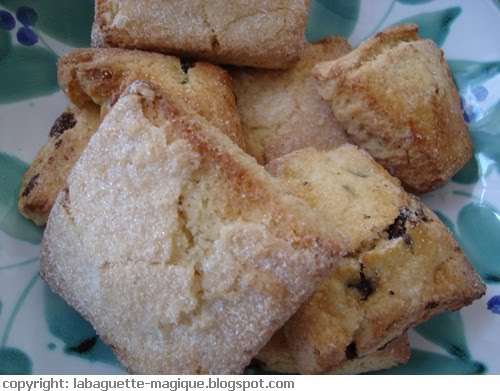
Apart from Fiadone(-tte), more pastry delights will await you at the local bakery, namely Canistrellis (aniseed or hazelnut-flavoured biscuits that are usually dipped in coffee), Cugolu (a boomerang-shaped aniseed-flavoured pastry that is also dipped in coffee), Cuggiolelle (sweet white wine biscuits), lemon-scented Frappi (a cross between a doughnut and a churros), and other variations.


Brioche is also well celebrated on the island, as Brioche au Sucre, an individual sugar-topped round brioche, or its oblong-shaped version, Pannette (also available with raisins). Besides be prepared to find innovative interpretations of traditional recipes, such as savoury bite-size canistrellis (olive or onion-flavoured) perfect with pre-dinner drinks, which are produced in the resort of Macinaggio (under Les Délices de Capo Bianco).

Chestnut-flour-based cakes are likely to be found in this blog, in local delis (and even supermarkets which, for many years, have been keen to stock local produce). Nougats, mountain honey and unusual fruit jams (watermelon, melon, mandarine, cédrat, arbouses, chestnut) will be handy to fly back home.


Finally there is an array of beverages designed to quench your thirst or prolong the holiday spirit well into the night, from local mineral/ spring waters (Zilia, St Georges, Orezza), lemonades (Carina Limunata, Oro) and Damiani cordials, to AOC* wine (white, Muscat, rosé, red, and the port-like Rappu wine derived from the Aléatico grape), with Patrimonio, Plaine Orientale and Cap Corse as the main wine producers.

Pastis Dami (Corsica's answer to Pernod), Cap Corse Mattei (a vermouth/ fortified wine), and chestnut-flavoured lager Pietra are guaranteed to jazz up your après-ski/ pool-house soirées. The island is also reputed for its strong liquors with an acquired taste: Cédratine, Myrte, Châtaigne (chestnut). Novices will find it easier to stick to Mandarine Impériale or Limoncellu (both of which also enter in the preparation of a number of desserts and refreshing cocktails).


Food taste is a matter of opinion, so why not forge your own by experimenting with those new or reinvented flavours, and decide for yourself. Whether it be sweet or savoury, earthy, traditional or adapted to the modern palate, derived directly from the terroir (land) or transformed, there is a food product for every taste, in Corsica. Enjoy!

* AOC = Appellation d'Origine Contrôlée

1 Aug 2010

Corsican Gastronomy - Delicatessen (Part 1)

To begin with, here is a universal truth: when in a typical tourist resort, authentic food specialities will not be found in the most obvious places, i.e. down the neon-streaked, fume-choked main road, sandwiched between the usual tourist trap shops and stalls (identified by their plastic made-in-China 'local' trinkets, dodgy postcards, overpriced bottles of local spirit that have been sitting in the sun day after day, the badly-translated holiday guides that have gathered more than their share of dust, etc.).

Fine Corsican food hamper, Bastia

The authentic will be found off the beaten track. In Venice, why settle for a coffee on the San Marco Plazza that cuts right into your daily budget, when the one ten minutes away will taste probably nicer for half the price and half the snobbery? In Sidari, why put up with nasty fast food, when an unassuming Greek taverna in nearby Perouladès will serve you the best mezze? In New York, why follow the crowds, when a wander round the block could take you to that hidden gem of a deli? The same applies to Corsica.

It pains me to witness those tourist trap restaurants dishing out the mediocrity of world cuisine to the holidaymaker on a budget or in a rush: paella, couscous, stuffed crêpes, spagghetti carbonara, steak and chips, lazy salads, greasy burgers, with often the only dish affiliated to Corsican gastronomy being soupe de poissons (fish soup), friture (catch of the day), or assiette de charcuterie corse (Corsican antipasti).


Hotel La Villa (Calvi, Corsica)

Meanwhile upmarket restaurants are often more preoccupied with presentation than substance, losing the remote Corsican theme into an artshow, balancing that slice of confied chestnut onto the tiny medallion of foie gras, the latter strategically placed on a designer presentation plate between two perfectly-formed carat-sized drops of premium arbouse jelly set against a constellation of champagne espuma... You get the picture. Yet traditional local fayre needn't be out of reach, expensive, fiddly or fuddy-duddy.

While not claiming to provide a comprehensive list of traditional food products you can expect to find on the island (with maybe a bit of detective work involved), this article will give you a general guideline, and hopefully tantalise your taste buds!


If there were only one speciality to try (vegetarians, please look away now!), it would have to be the incredibly tasty smoked, seasoned pork-based Corsican charcuterie that is fairly reminiscent in taste of the Italian dried pork meats: Prisuttu (Corsican ham, slightly darker and thicker than Parma ham), Lonzo, Coppa (both smaller versions of the Prisuttu), Saucisse Corse (a peppery aromatic saucisson sec), Pancetta (strictly nothing to do with the so-called Italian pancetta that UK supermarkets churn out!). You will also be able to purchase wafer-thin Parma ham.

Figatelli pork sausages are a winter culinary must, preferably cooked on an open fire (or be prepared for a lot of smoke in the kitchen) and pressed with their juices between two slices of freshly-baked bread, and you have the Ford Mustang of hot dogs, according to I. Other deli staples will include speciality meat pâtés (mainly wild board or black bird), Corsican olive oil and pistou (pesto). (to be continued)

P.S: Further observations on Corsican charcuterie from The New Gastronomes

19 Nov 2009

Choc-a-Block! (Part 2)

Yet you will find pure cocoa and traditional drinking chocolate safely tucked away in my kitchen cupboard. I mix them together in order to obtain the perfect balance between sweetness and bitterness, before adding to organic semi-skimmed hot milk for breakfast. Indeed, I have hot chocolate in the morning - not the evening - mixed with some unsweetened Swiss muesli to add sustenance to breakfast. This seemingly peculiar gruel sets me off for the day and wards off any food cravings until lunchtime (unlike popular brands of sugary cornflakes or the toast-and-butter/ jam combo which neither seems to fill you up for long!).


Chocolate bars are a fairly inexpensive and convenient way to treat yourself, either on the go or at home. My own taste in chocolate meets certain requirements: the cheaper brands that dilute the taste in no uncertain quantities of hydrogenated fats and sugar are snubbed. I generally prefer the ‘continental’ taste, described as being less sweet than your average confectionery brands and popular chocolate snack bars (although I will make allowances for those wafer-based favourites like KitKat and Blue Riband). The continental taste bars are mostly represented by Lindt, Milka, Green & Black’s, Divine Chocolate, and selected ranges by Thorntons and Hotel Chocolat.

By the way, sorry to disappoint (or pleased to reassure you!), but I am no chocolate purist (in the chocolate purity sense of the word), as I am not a fan of those 85% dark chocolate bars (although this is chocolate at its less adulterated form and therefore at its truest taste!). Ironically it may be because it tastes too much like real chocolate, an acquired taste after all!


On the subject of chocolate variants, a special mention however to pralines/ giandujas (found in Ferrero Rochers and Nutella!)... Again, did I mention anywhere in this article that I was a chocolate purist…

Onto the next level, I dispense with special occasions in order to justify my enjoyment of the more sophisticated side of chocolates, the ones displayed in presentation boxes, in their shiny foil or veiled in a cocoa, icing sugar or mocha dusting, teasing your eye with their lashings of packaging, secretive layers and evocative descriptions from the menu card… I will try to pace myself if I am in company but if, for instance, my partner randomly orders a surprise box that is ‘just for me’, I am afraid those treats will have signed their own death warrant the moment the box is deposited in my hands…

If chocolate is your weakness too, then resistance is futile! Give in to it because it is, after all, one of life’s little pleasures!

Find out more - brush up your chemistry: Neuroscience for Kids.

18 Nov 2009

Choc-a-Block! (Part 1)

I have a confession to make. There is a love in my life that has burnt a fire in my heart for as long as I can remember. This love is nothing to do with a quick burn-out affair, a fleeting passion that comes and goes with the seasons, or a reasoned affection. This love is more like a single-sided devotion on my part that will forever stay with me, leaving me appeased soon enough until satisfied again...

This is not Lord Byron enthusing about a lover, only humble I waxing lyrical over one of life’s little luxuries: chocolate, in rather hedonistic terms - I must concede (where’s my head at!) - but the word is as potent as it tastes, stirring emotions in me and bringing pleasure to my tastebuds and respite to my sanity!

Chocolate is synonym with food comforts, and one of those treats described as péché mignon (the cute sin) in French, the bon vivant’s allegorical excuse for indulgence bordering on the deadly sin of greed!

Clockwise from top left:  Thorntons, Van Houten, After Eight, Hotel Chocolat

According to ancient Aztec/ Mayan beliefs, chocolate used to be the drink of the Gods, certainly of society’s privileged few, bestowing powers. Chocolate was also used as a trading currency. The moment Conquistadores got acquainted to this treasured commodity was pivotal in defining and refining a new chapter in Western civilisations’ gastronomy.

A complex chemical reaction happens in the brain when the latter is stimulated by chocolate consumption. Chocolate compounds encourage the increase in serotonin and dopamine levels, therefore triggering the well-publicised mood-boosting effect one experiences on consumption. Chocolate as a mind-altering drug – I hear you gush – is the truth in principle, with the added advantage that the effects are mild, safe and legal!


However chocolate is also addictive, and I am probably a good example of this dependence. Although Choc and I go back a long time (early childhood), for the last 10 years, I have probably had it one way or another as part of my daily diet and, as such, we could safely deduct that this is one of my staple kitchen ingredients, although the bar form tends to be found in close proximity to the sofa – for a very brief period only – before disappearing! (to be continued)

14 Oct 2009

T is for Tea

After dedicating a post to one of my staple food ingredients (sea salt), I thought I would take the liberty to explore with you another of my 'capsule wardrobe' ingredients, one which – should you knock on my front door unannounced – you will be assured is stored in my kitchen cupboard, no matter the day of week or time of month!

I may intermittently run out of essentials like bread, fruit juice or chocolate (who’s the culprit?!), but I’ll always be safe in the knowledge that my extensive collection of teas and herbal teas will last me for months. These are probably not everyone’s cup of tea (so to speak) but as far as hot drinks are concerned I like to keep my tea options open.


First I should perhaps clarify the fact that I am not a fan of ‘everyday’ English tea, the one that is spurn out in tea bags from the big brands off the supermarket, and needs to be drowned in milk and sugar to make it remotely palatable… I won’t give names but I’m sure you'll have an idea. Having said that, the irony is that I do store it in large quantities, due to the fact that my partner is an avid ‘everyday’ tea drinker…

However my personal selection of teas is eclectic and includes loose and bagged varieties, mainstream brands and the more connoisseur products. Just to give you an idea of what I have in store right this moment:

  • Mainstream: Twinings Earl Grey; Tick Tock rooibos tea (with redbush, a caffeine-free alternative); supermarket own brand peppermint tea (admittedly a very poor alternative to the freshly-picked, freshly-crushed garden mint ingredient!); Twinings Digestif Tea (a mix of peppermint and fennel to aid digestion)
  • Connoisseur: Earl Grey (from Stokes, a renowned tea and coffee house in Lincoln); ‘Mona Lisa Smile’ (a romantic blend of loose green tea and dried rose buds, purchased from Geels in Amsterdam).


Undoubtedly my moods and the availability from shops I visit influence my choices. In the last 12 months, the following were also part of my collection:
  • Mainstream: Loose jasmine tea (supermarket own brand); Clipper’s white tea with raspberry-flavour; fruit infusions from Tetley
  • Connoisseur: Brewhaha rose tea (a potent black tea, delightfully flavoured); a tiny tin of framboise tea from Geels (which I consumed in extreme moderation!); Farrer’s Lakeland Special Tea (a holiday present); bergamot tea from Imperial Teas of Lincoln (a specialist tea and coffee house on Steep Hill)…
If it is claimed that variety is the spice of life, the saying definitely applies to my approach to tea concoctions and infusions! Why stick with the one when you could enjoy more! And you needn’t feel guilty about those little pleasures, a little goes a long way, and they will therefore be cheaper than chocolate! Now on to some serious business: let’s put the kettle on…

3 Oct 2009

Petite Fantaisie Numéro 1

As my staple food ingredients, little unassuming marvels are hidden in my kitchen cupboards, and although one may be hard-pushed to taste the difference that they deliver on the palate once they are mingled with food, they give me pleasure to use. The first ingredient I am about to describe couldn’t be more mundane though, more trivial, more basic than this 4-letter little number: salt.

First let’s put this straight: my household is not a big consumer of salt, and to prove it, it took us 7 years to go through a pot of 500g of the condiment. Everyone knows (should know) that despite its seasoning and taste-enhancing properties, and the fact that it is an essential component of our diets, salt should be consumed in moderation.

Therefore why would I have two different variants of salt in the kitchen, and why would I even dedicate a whole entry to this ingredient if it really doesn’t play such a big part in my cuisine? Let me explain...


I have never been a fan of refined salt - also referred to as ‘table salt’, the most commonly available type in the UK: cheap, straight-forward, no-fuss salt-of-the-earth kind of salt. Besides, call it snobbery on my part, but the big plastic container it comes into is not visually savoury (excuse the pun!). I know that the universal popularity of the contents (salt!) doesn’t require to call in the big advertising guns from London for a rebranding exercise, and you can pour the salt into a nice little holder and hide the plastic carbuncle away!

It’s only a matter of opinion but I do prefer sea salt, probably by default, as my mum has always bought it. Funnily enough, this conscious choice takes the sea salt consumers to a different league, that of the connoisseur’s, because the stuff is more expensive and exclusive, and yet – let’s admit it – tastier, thanks to its iodine content. It also makes us look somewhat particular, because for most people salt is just salt. Actually it’s not, because it would be like saying that sugar is just sugar, or coffee is just coffee… And while you’re at it, try to tell Colette that water is just water…


One of the two salt varieties in my cupboard is Maldon Flaky Crystal Sea Salt, which is poetically translated into French as ‘fleur de sel’ (i.e. salt flower). The natural harvesting process means that the flakes are unadulterated in flavour and content (no anti-caking agents!), and they deliver a nice burst of saltiness without the bitter after-taste, and melt quickly on the food. I find that they enhance salads very well.

The other salt variety I favour was brought to me by my mum, directly from the health shop: Lanes Herb Salt, an aromatic sea salt and vegetable seasoning (celery, carrot, kelp and herbs), which I sprinkle on pretty much all savoury dishes, and in the cooking water of pasta for added flavour.

13 Sept 2009

Culinary Heritage - The British Convergence

Other influences have converged to shape my tastes and culinary aspirations along the way, with the most obvious one resulting from my move to the UK 15 years ago. There are deliciously British dishes that one should get acquainted with when coming over here, as part of a rite of passage that puts the foreign visitor on a par with the locals, whether it be over a mug of builders’ tea, a pint of traditional ale, a tumbler of sloe gin on ice, or a cup of the finest Darjeeling.

To face the day head on, forget about your bran/ shredded wheat and plump for the Full English Breakfast, very nutritious! For a lighter alternative, why not have toasted teacakes (not to be confused of course with the coconut 'toasted teacakes' from the local sweetshop, pictured here with coconut mushrooms!)


Variety is on the menu for lunch or dinner, from casual and easy to heart-warming and cosy! How about potted shrimps, scampi, pork pie, steak & kidney pie, curry, fish & chips, fisherman's pie, baked beans on toast, Lancashire hotpot, cottage pie, Yorkshire puddings… And if you are feeling adventurous enough ask for a side of mushy peas, or the cucumber-sized gherkins, or bump up your 5-a-days with a plate of oven-roasted parsnips or that delightfully light pea-shoot salad.


For dessert, succumb to sweetness: apple pie, trifle, bread & butter pudding, spotted dick (and their lashings of custard), syllabub, treacle tart, Bakewell tart, Victoria sponge cake, lemon-drizzle cake, or walnut & coffee cake (my personal favourite!) And let’s not forget high tea and its platter of sinful delights: savoury finger sandwiches, scones, crumpets, Battenberg, tartlets, fairy cakes and other bite-size wonders! (Pictured above are some little fancies made earlier by Mr Kipling!)

If variety is the spice of life, there is no better place than Britain to enjoy chutneys, Piccalilli, pickles, ginger, cinnamon and a variety of other spices harking back to the colonial days which more than ever take pride of place in modern British cuisine.

10 Sept 2009

Culinary Heritage - Mum (Part 2)

Always one to spot a culinary trend in the making, mum introduced the family to avocados, kiwis and lychees in 1979-80, courtesy of our local organic retailer, La Vie Claire, which was a food pioneer of the times. On her weekly shopping trip to the store, she would purchase eccentric ingredients (for the times!) from palm oil (which she would use in the deep-fat fryer as a substitute for ordinary cooking oil), cider vinegar, strawberry juice, wholemeal bread, carob spread, Demerara sugar, and of course a small selection of organic fruit and veg.


Mum was (is) no hippie despite her slightly off-the-beaten track food choices; she was (is) more certainly a health-conscious consumer who back in the 1970s started questioning her chicken, her drinking water and her grapefruit as scare disaster stories made the news, from radioactive waste to nitrates, from growth hormones to antibiotics…

Even today, well into her 60s, mum still keeps up to the minute with culinary trends and currently serves most of her entrées and desserts in verrines (namely transparent serving glasses) with cleverly displayed food layers as strong visual elements emphasising colour and texture that give justice to tiramisus, trifles, Eaton messes and the like. She still manages to surprise me with her new recipes and lust for food. Recently her incredibly refreshing Limoncello and melon cocktail went down a storm!

To name but a few of mum’s cupboard/ fridge staples, we’ll note chard, lemons, chestnut purée, tinned macédoine, a variety of ground or slivered nuts, capers, anchovies, tinned tuna, liquid crème fraîche, and also the odd jar of raisiné (a traditional Corsican fig, walnut and grapes jam).


I admire my mum for her effortless yet passionate cooking. Cooking goes beyond its primary purpose of feeding loved ones, it is also a social activity, gathering friends and family around the table for shared moments of joy and happiness. And, with someone like my mum, cooking is also an art form: the art of presentation, and the subtle touches that indicate that her meals are a labour of love, not a chore, and for these I am grateful!

9 Sept 2009

Culinary Heritage - Mum (Part 1)

My mum embraced Mémé’s influence and the culinary heritage from their elders, and pushed the boundaries further. She happily cooks earthly no-nonsense northern specialities like Soupe à l’Oignon, Flamiche aux Poireaux (creamy leek pasty), beetroot-based entrées, endive gratins, Hachis Parmentier (French equivalent to cottage pie), Tarte au Sucre (sugar-topped brioche) and Tarte au Potiron (pumpkin flan tart).

She also beautifully pays homage to her southern origins with her Veau aux Olives (veal in a green olive sauce), Soupe au Pistou (basil soup), etc. Her skills extend to other French specialities, whether it be Cassoulet, Boeuf Mode (beef and carrot stew), Lapin à la Moutarde (rabbit), or Choucroute Garnie (sauerkraut). She has also conjured up more ambitious time-consuming recipes, from pâtés and terrines to salmon en croûte, Pièces Montées (tiered profiteroles) and - my personal favourite - the Paris-Brest (choux pastry gâteau with a rich praline filling).

When over 20 years ago the family went through the credit crunch, mum bravely purchased a potato recipe book and vowed to cook a different potato recipe for each day of the week! The prospect might have deterred a few cooks, but not my mum who still managed to keep the menu exciting and that winter we went through two big sacks of potatoes from a neighbouring farm without feeling disadvantaged or impoverished in any way! Potato casseroles, Gratin Dauphinoise, Pommes Lyonnaises, stuffed potatoes served in a homemade tomato sauce, röstis, creamy mash, hot potato salads: variety was definitely the order of the day despite the humble spud as its common denominator!

Mum is more than a cook, she’s an ambitious cook and deserves a rosette for catering for family reunions in excess of 25 guests, christenings, communions, engagement parties, birthdays etc, all by herself (without losing too much composure!). Not many home (i.e. non-professional) cooks would be able to claim such an achievement, and Come Dine With Me (TV cookery challenge) should probably present itself as a leisurely doddle to her!


Her flair and savoir-faire span from the kitchen worktop to the dining table, way before table accessorising had become fashionable: from floating candles, personalised placemats, individual orchid favours and fancily folded napkins, to special occasion tableware, without omitting the perfectly ironed tablecloths, most of them embroidered heirlooms passed down from generation to the next, which would inevitably be stained with red wine or chocolate sauce by some clumsy guest, but which she would deal with a smile. My mum the ambitious cook, is also the table designer and hostess, handling a conversation and making sure everyone is enjoying themselves while effortlessly juggling with dishes. All of these put together define the Art of Entertaining. (to be continued)

8 Sept 2009

Culinary Heritage – Mémé


My dear grandma, mémé Angèle (who sadly passed away in 2006), was my friend. She spent the first 36 years of her life on the island of Corsica, in the family village, before emigrating to the north of France after WWII (and would return to the island every Summer). Her cuisine, although embracing the best of north and south, always had a hint of sunshine, sweetness and generosity to me, whether this was achieved with a dash of garlic, a touch of basil, an extra helping of butter, indulgent simmering over the stove, or simply with a grandmother’s know-how.

She would take me back in time to a bygone era of kitsch, whizzing up those delightfully 1950s Tiki desserts: Savarin Délicieux (pineapple sponge cake), Baba au Rhum (rum-infused sponge cake), Cake aux Fruits Confits (glacé cherry cake), or a rich Crème Pâtissière (entremets which she would finish off with a twirl of liquid caramel) served with Langues de Chats biscuits.

She concocted the best tomato sauce that dreams are made of, using carefully-chosen seasonal Corsican tomatoes, wild Corsican marjoram picked up the very same day, bay leaf from a nearby bay leaf tree, onion, garlic, touch of salt, one sugar lump (the magic ingredient that takes away the bitterness from the tomatoes) and ounces of patience, keeping an eye over the gently simmering saucepan, stirring when needed, with poise and a glint of joy. The whole house would bathe in the comforting aroma, and you - as a young person - would feel instantly hugged by it into a sense of security. You believed that the glorious home cooking from nanas like mémé would put the world to rights, keeping adversity and hunger at bay.


Mémé would provide me with home-comfort meals, as only a grandmother like her could: Oeufs Mimosa (hard-boiled eggs cut in half and stuffed with homemade mayonnaise and crumbled solid yolk), assortment of selected cold-cuts from the charcuterie (deli), creamy polenta (so golden, fluid and buttery it looked and tasted like a rich potato mash) served with Escalope de Veau (veal), aubergine ratatouille (fragranced with the intoxicating aroma of wild Corsican marjoram), and for afters Clafoutis aux Cerises (cherry flan) or Far Breton (prunes flan, a Brittany speciality).

Her odd but trusted larder staples included tapioca, angel hair pasta, chestnut flour (annual Christmas shipment from her Corsican cousins), salsify, hearts of palm, artichoke hearts, tinned pineapple rings, Pain au Sésame (a sweet sesame bread), testimonies to post-war awakening to culinary indulgence and exotic influence. She also, like me but unlike my mum, had a penchant for tea.

Mémé was particular if not meticulous about her food shopping. Fruit and veg were always purchased from the local farmers’ market, while she was prepared to pay the price for the best Parma ham in town, from the Italian delicatessen, and would treat herself and immediate family to palate-pleasing delicacies from Pâtisserie Henri, an institution of indulgence back in the day! She would not suffer fools with sub-standard produce and her high standards certainly helped define my own.


Mémé would run her errands in style, wearing her trademark scarf, dainty low-heel court shoes and a matching millinery hat. Her attire made her look like a plumper shorter version of Marlene Dietrich (she would so disagree with me if she read this!), certainly a lady who took the best try-and-tested from a past era that suited her faultlessly. Mémé wasn’t rich but appearances and the way you present yourself to the outside world were everything to her, and I do respect this, especially in this age of slovenliness.

Mémé indeed is one of my main culinary influences: a lively and passionate people person, whose cooking delivered a twist of the exotic with gusto! She embraced life in style, her heart always in the right place. Her light-heartedness brightened the day, but behind those laughs stood one thoughtful and very sensitive woman. And although her values were steeped in tradition, they also had a tinge of modernity and quiet rebellion.