Showing posts with label 1970s. Show all posts

16 Feb 2018

The Deconstruction of the West: A Warning

Turbulent times afoot! Is our fast-changing world changing for the better? Does your past suddenly embody 'the good old days' and you're starting to sound like your grandparents while your kids haven't even started high school yet?! You are not alone on this. It is getting increasingly clear that the deconstruction of our modern Western civilisation has been masterminded from way above, by the nameless, faceless upper echelons of the multi-layered cake that symbolises the intricate hierarchical global governance nerve centre whose scope of influence and decision-making via institutions, institutes and foundations criss-cross regions, nations, continents, faiths and cultures in ways unfathomable by us the commoners. Yet it appears that a warning of things to come had been intimated as far back as 1969.

Minotaur, gypsum sculpture by Emil Alzamora (2006) (pict source)

If you are in your forties like I, you will have enough scope to be able to draw up a rough comparative study between what you remember from your childhood years in terms of societal environment and the way society has turned out to be. Your elders will probably have brought enough food for thought to you through observations of their own. Compared to my early experience of it, I do not recognise the West - and this I say without exaggerating.

I had noticed a shift (although I couldn't formulate it at the time) as far as the early 1980s, when disindustrialisation became prominent, and the textile, steel and coal industries were blitzed out of existence from their production centres. I witnessed it first hand in my French northern textile hometown of Saint-Quentin. And it became increasingly apparent that political figures all the way up to the President had been complicit in the demise and let those production towns down like a bad memory: they saw them as an embarrassment. We were silenced, urged to get used to it sooner rather than later, there was no turning back. And when I say let down, I mean a total collapse of the local economy and high unemployment rates (20%+) as a direct consequence, that shot up almost overnight. The powers-that-be coined a word, a magic word, that would explain it all and reassure us, and most importantly which we could blame for all our misfortunes: 'recession', the new normal.

Model: Cloud, sculpture by Maggie Casey (2006)

Oh, the governmental bureaucrats, business analysts, poncey economists, know-it-all journalists - and even your own boss or auntie Céleste after hearing their lecturing speech on the telly - wouldn't leave it at that. They shifted the goalpost. They pointed the finger at the unemployed and the soon-to-bes. Those were the culprits! They were criticised for having been too greedy, for demanding less working hours, better working conditions and higher standards of living. Can you believe that it was ultimately their fault if the factory had to close down altogether or relocate its operations to the Far East?! They had to pay the price and fellow countrymen became divided over the hot topic. And the bureaucrats nailed their despise for the Labour Force further by accusing the French of shunning factory work like it was beneath them. That only foreign, emigrant workforce were willing to work on the assembly lines now. Another fallacy and a sure dividing point that would fracture further the nation. 

Rule of Thumb No.1: Divide and conquer.
if you seek to rule, create division and chaos.

During the 'recession', swathes of working- and middle-class took a hit and lost their jobs before they could even save for a rainy day. Those who yesterday (i.e. after WWII) had rebuilt the country up now found themselves in forced redundancy. They became redundant from work and from life. They were forced to exchange their usefulness, their skills, their craft, their trade, their experience, their diligence, their dedication, their pride, for a cheque from the government. Forced to leave their neat little semi-detached whose mortgage they could afford no more for the 'joys' of subsidised housing, stacked up like unwanted goods on shelves. They had become unwanted goods. Now they had to learn to become invisible.

Public-private partnership agencies mushroomed out of the woodwork. Those were supposed to come to the rescue of the unemployed. All they did was skewer the job statistics by shunting them from one category to another, through retraining schemes more akin to a brainwashing session to realign their psyches so they became acceptant of their fate, and live by on governmental aid and be thankful for it. The industrial West was becoming a thing of the past. The skilled guipure operative was urged to retrain as a supermarket shelf stacker. And her husband, formerly a steelworker, to do part-time pizza delivery. That's where the demand was at.

In my life journey, I have come across much wasted talent, countless wasted lives, lives that could have accomplished but whose talents were stunted out of existence or side-tracked. Graduates like I who didn't want to end up on the dole had to export themselves overseas for work and not be choosy. Is this the way for a nation to operate? Waste its homegrown talent away or force it out of its borders?

Encyclopédie de la Vitesse, Editions Hachette (1956)

In the Western society model, strong precepts had prevailed until the 1960s/ 1970s. In France we had a glorious moniker for it: les Trente Glorieuses, three decades of full employment and buoyant economic activity (approx. 1945-1975), boosted by the aftermath of WWII (reconstruction) and the move into the consumer-centric technology-savvy model, a boon!

This was held together by an unshakable moral, socio-economic code of conduct. Back then, our society structure would put strong emphasis upon the Nation State: civil rights and civil duties, undefected pride in one's nation. Patriotism was embraced unconditionally, not derided.

No knees were taken when the national anthem played: 
you stood up and honored the fallen and the living 
under one flag!

Respect for Law and Order was tantamount to a functioning society, where the State ensured the protection of its people and the people paid their respect through national identity and pride, and served their Nation when national security was threatened (war). Rights and obligations of the people towards their Nation and of the Nation towards its people, a strong economy and buoyant industry sector, with wares manufactured locally/ nationally. All of these concepts, still prevalent in the 1960s, incrementally deliquesced to the point that they have now been turned on their heads.

Family and religion were still strong in the 1960s/ 1970s but the communist, marxist, trotskyist, socialist, atheist, feminist and other activist movements did not help the cause; if anything, they fragilised it. In fact, neither do they unify nor pacify: they instead harbour division and disfunction. Bingo, all that the elites want!

As we are getting more enlightened to what really is happening to us and refute the mainstream media's fabricated truths, we come to the realisation that the economic decline of the West as we view it today had been orchestrated all along. And some of the evidence points out as far back as 1969 with Dr Richard L. Day's infamous speech. His 'predictions' turned out to be accurate.

2 Sept 2017

Mireille Darc, a Role Model for French Women

Mireille Darc was more than a French actress and a household name. I would go as far as describe her as France's sweetheart - and by the same token as the understated embodiment of the French woman inside and out. With a first name that sings the sunny South of France (my mum's name!) and a surname that is a tribute to Joan of Arc, you are off to a good start!

Mireille Darc, the quintessential French woman!

Mireille was a leading actress in her younger days, a valeur sûre: effortless, true to self, a natural. Yet her film portfolio might not be considered consequential by those cinema purists who shun popular modern-day stories and comedies of errors about ordinary life. No superheroes, special effects, Shakespearean tirades or costumed dramas in sight. What interested Mireille was to portray life as it happens, without artifice.

Mireille Darc and Alain Delon: each other's biggest love in life!

A word of caution: to confine Mireille to her movie acting days would be to rob her of her vibrant off-screen personality, philanthropy, grace and kindness, her business acumen, her second career as a successful TV documentary-maker, and her involvement in TV series and theatre roles later in life. The smouldering beauty was also a muse - not least to the love of her life, the incandescent French actor Alain Delon, and a loving second mum to her stepchildren.

On screen and off screen (pict source)

Mireille was driven: a plate-spinner, fingers in many pies lady. Starry-eyed and an award-winning dancer, she left her native Provence at the age of 21 for Paris where she intended to make it. She never looked back!

Unlike many of her contemporaries (Jeanne Moreau, Brigitte Bardot, Claudia Cardinale), Mireille remained timeless, ageless. She kept her slender figure, impeccable dress sense, elegance and positive attitude. Not to mention her fresh face, trademark sleek blonde bob, beautiful gleaming smile and a glint in her eye that made her the endearing mother, sister, best friend and confidante all along. She didn't let age get in her way: who would have guessed she was in her late 70s?! She kept her health problems under wraps, behind close doors, only for the very close few; she wouldn't have allowed it to vanquish her.

Even after splitting up in 1983, those two remained close till the very end! (pict source)

Mireille's legacy is multi-fold: she is a case in point, not only to young actresses but also to women in general. She shows us how to incorporate longevity into a career, stay grounded, focused, true to self, open to opportunities that ring true to us. Follow your heart, love with all your might, stay loyal. Stay strong and do not get mislaid by the deadly temptations of the art world, excesses and burn out. Ironically very few actresses paid their respects to Mireille on her funeral yesterday. Yet the populace was there, crammed outside the gates of the Saint-Sulpice Church in Paris: they didn't let her down! Mireille was one of us and never left us. She lives on in our hearts.

13 Sept 2016

A Creative Illustrated Approach to the Bible

One way to deal with our troubled times, our modern day predicament whatever this might be, is to hark back to the past in order to seek solace, answers or simply to solidify the grounding of our core beliefs - faith for instance - that sit within the cultural territory of our heritage. And the revisited, nurtured grounding might just give us that extra footing so we can face the present more comfortably, with more assurance. Look at it like a watered, tendered, tilled garden. Or a book whose written content is interlaced with pertinent illustrations.

The Biggest Story by Kevin DeYoung, illustrated by Don Clark, via Invisible Creature

The purpose of this article is not for me to go all religious on you or for you to feel put off by the seemingly heavy topic of religion. The approach to and treatment of topics like religion (or philosophy for that matter) shouldn't need to be heavy either. I believe that the key to get children and adults interested in a book like the Bible, the way to make it appealing to them is visually: colourful, purposeful, unleashed creativity! I believe in the healing power of graphic design and how its magic and soothing, positive aura help tackle the (potentially) life-changing publications like the Bible, and outreach to a new audience or get them rediscovered. If I were to head the Ministry of Education, graphic designers, illustrators and other creatives would hold a pivotal role!

As a collection of sacred texts in Judaism and Christianity, compiled under the Old Testament and the New Testament, the Bible guides Jews and Christians in their spiritual journey. Christian believers should be somewhat connected to, acquainted to or familiar with the Bible, depending upon the depth of our relationship with faith and how much of a practicing believer we are. 

ibid.

The Bible, whose complimentary copy deposited by The Gideons in hotel rooms might be the closest some of us will ever get to in physical terms, and the closest opportunity to the path to spiritual enlightenment, yet a book which we might sadly only open if deprived of lighter reading matter, mobile devices or other forms of hotel 'entertainment'. Now if the Bible, or an introduction to it - which might suffice - were a pictorial feast like The Biggest Story: How the Snake Crusher Brings Us Back to the Garden, written by Kevin DeYoung and illustrated by Don Clark, in a carefully-summed up, loving way that resonates with faith neophytes, chance is we would take more than a last-chance-saloon interest in the Bible!

Illustrations have the power to reconnect us with serious topics, and reawaken us, rekindle the flame within. For some, it might just be enough. Others might delve deeper, reach out for a de-facto copy of the Bible and start reading the Scriptures and maybe befriend the local church. As an aside, just think what a little illustrative licence would do to Tolstoy's War & Peace?

ibid.

Cultural heritage is certainly what children need so they get their sense of identity and belonging and grasp some form of understanding about the greater things in Life, the greater scheme of things that span the seen and the unseen, without adults tampering with it, getting all metaphysical and complicating it like only we know how.

By the way, I didn't grow up within an overzealous Christian family but my mum made sure we would attend church at least once a month. I was christened as a baby and when I was about 9 years old followed catechism, a weekly hour-long religious education syllabus provided by the local priest or his aide as a way to prepare us kids for catholic communion.

ibid.

To be honest, I can't remember a thing from my religious classes. Most of all though, what left a lasting impression on me and provided me with the tools that in turn helped develop my curiosity in God and the Universe, my spirituality, my critique, my imagination also, and the on-going willingness to find out more were those illustrated books that I had got from my parents and other relatives throughout my childhood. They were almost as visually-pleasing as The Biggest Story and they sure left an impact.

Richly-illustrated, graphics-driven, full-page decorative, symbology-strong children's books like The Biggest Story are bound to appeal to the young and the less so. They are the most enticing introduction to the Bible, a book that needs no introduction and yet that is daunting for a non-practicing Christian to open, or for a curious non-believer or the member of a different faith. Learning and personal development should be fun and visual appeal will facilitate it.

Limited edition 6" x 8" 'Ascension' print, ibid.


The Biggest Story: How the Snake Crusher Brings us Back to the Garden, by Kevin DeYoung and illustrated by Don Clark, was published by Crossway, Wheaton, Illinois in 2015, 132 pages. Kevin is the senior pastor at University Reformed Church (PCA) in East Lansing, Michigan. He serves as a council member at the Gospel Coalition, as Chancellor’s Professor of Systematic and Historical Theology at Reformed Theological Seminary and is a PhD candidate at the University of Leicester. Don is an artist and the cofounder of Invisible Creature, a widely respected and award-winning design studio based in Seattle, WA. The book is available to purchase from Invisible Creature and Amazon. Don't miss out on the free 25-page PDF preview!

ibid.

"The Biggest Story is a delight to the eyes, ears and hearts of its readers. With rich illustrations and even richer text, the biggest and best story is presented in all of its vivid colors - every dark shade and every bright tone. Parent and child alike will feel the ache of the fallenness of human nature and the comfort of an always-faithful God. From our family to yours, we wholeheartedly commend this book!" - Matt and Lauren Chandler 

9 Jul 2016

Shirley Baker: Snapping the Ordinary to Write Local History

Of my 16 years living and working in Manchester, England, my biggest regret is to have taken hardly any photos of the city itself, so caught up was I in my own life, and whenever I had a moment to snap away, it would be outside the city boundaries, down the scenic coast, up the Lakes, a nature preserve or a quaint photogenic Peak District village. Manchester didn't come to mind because I lived there, and I was of the opinion back then that photography had to be escapism from everyday life.

'Two Girls Swing on a Lamp Post', Hulme, 1965, photography by Shirley Baker, via The Photographers' Gallery

Thankfully some talented - yet unsung - individuals like Shirley Baker (1932-2014) have meticulously reported back from the nitty-gritty of the frontline. For it would be a great loss to local historians if the photography-enclined had all overlooked Manchester the way I did because then the fast-changing socio-economic fabric of this industrious mill city and its industrial demise followed by its reinvention as a service- and leisure-driven metropolis wouldn't have been captured and immortalised in this poignant visual exactitude that words fail to transcribe.

"If I could say it in words there would be no reason to paint." - Edward Hopper

Shirley Baker got late recognition in life for her work as a street photographer and photojournalist of the mundane, snapping street scenes, capturing life as it occurs, spontaneously, lived by the ordinary folks, not the celebs, not the royals, not the captains of industry. She was her own Robert Doisneau and Henri-Cartier Bresson, the latter she admired. She made it to the broadsheets (The Guardian and The Telegraph) obituaries when she sadly passed away, which is - I guess - a form of posthumous recognition of her art and talent.

'Women and Young girls out in the Street', Hulme, July 1965, ibid.

Meanwhile I am looking up to the Mancunians (the inhabitants of Manchester), who since the inception of the Industrial Revolution, from the rising of Cottonopolis to the post-industrial cultural errances of Madchester and beyond, have had to adapt to an ever-changing physical, social and financial landscape and show resilience, acceptance and adaptability to conditions forced upon them, and ultimately turn away from despondency, and turn adversity into opportunity in order to survive the transformation and earn a living within a reconfigured, unrecognisable city. I would sum it up this way: -

Manchester is - despite itself - a fascinating social laboratory and an architectural experiment that has explored - and keeps exploring - the good, the bad and the ugly. 

One of my personal observations that resulted into my 202-page University research paper about land planning management programmes in post-WWII Manchester, is how historically the northern city has been treating history: ruthlessly. This was accomplished along the years in a series of high-profile public, private and mixed land grabs and compulsory purchases repurposed as redevelopments, some of which badly needed (the slum clearances) and others of a more questionable nature. Redevelopments were/ are not solely limited to Manchester, for the blueprint was/ is applied to other major cities and their satellite towns.

As unconventional as I may sound, I  believe this is the way that Britain as a socio-economic collective deals with the past, and how this ruthlessness helps it move on. The nation refuses to dwell on the past too long for it refuses to become complacent and dictated to by nostalgia. It does however boast 500,000 Grade I and Grade II listed buildings, fondly and meticulously preserve traditions and memories (through, for instance, extensively-documented WWI and WWII commemorations, and lavish Royal protocoles), painstakingly curate ancient artefacts into museum collections, and document the past via specialist research and education institutes.

'Young Girls playing in the Street', Hulme, 1965, ibid.

Yet at the same time the nation's history shows how quick it is at making a clean slate out of, not just a couple of old buildings at a time, but large swathes of land, several streets at a time, that have been deemed ripe for redevelopment by a clique of office suits removed from life on the front line.

These drastic changes occur at the expense of the local communities that keep getting fractured, both externally and then internally, and lose their cohesion and identity, as the wards face their redundancy and economic fragility head on and their weakened state attracts social underdogs and castaways (drop-outs, thugs, drug dealers), who drag the wards down further through a climate of fear, before the bulldozers move in. The clearance of old housing stock started in the 1930s and resumed after WWII. Between 1955 and 1975, some 1.3 million homes were demolished nationwide to make way for modern accommodation with comfort and sanitation. However those came at a cost:-

"(...) many of the people lived in dreadful conditions and their houses had to be pulled down. Then of course, when they built up the new stuff, it wasn’t very long before they pulled all that down too.”- Shirley Baker

Let's bear in mind that Britain has been ruthlessly quick at wiping out its heavy industry and traditional manufacturing base over the last sixty years, leaving only a few traces here and there of its industrial past. And then the socio-economics that are linked to those sectors of employment have too been obliterated. In this 'sink or swim' environment, unless the locals move away altogether or retrain and relearn (which is not always possible), they become casualties, and long-term unemployment a fatality. Alvin Toffler's Future Shock springs to mind.

'Cycle Salesman', Hulme, 1965, via BBC

By making that clean slate, government officials, financiers, investors, economists, land planners, property developers, each contribute in effect, to directly or indirectly wipe out the architecture, culture, social fabric, heritage, legacy that root in the communities. The blue-collar workers, or what is left of them, are the social demographic most likely to be displaced within the city: the now-redundant factory workers and miners and their families, now either essentially workless and put under the patronage of the State through total Welfare dependency programmes for subsistence, or they take that post-industrial leap into unskilled low-paid service jobs, joining the ranks of the working poor.

"I cannot claim that my photographs represent anything other than a few wisps teased from some of the countless threads that form the intricate tapestry of our lives.” - Shirley Baker

On my last visit to Manchester 21 months ago with my mum, we drove through parts of East Manchester (namely Ancoats, Ardwick, Beswick, Gorton, Openshaw and Denton) and blimey, did I struggle to recognise anything! The last time I had driven down those areas had only been five years prior, in 2009... It seemed that what was left of the old industry-related (Victorian mills, depots, warehouses, sheds, traditional two-up two-down terraced houses and their end-terrace corner shops, workers clubs, stores, picture houses, small pubs, local banking institutions, etc.) had made way for sprawling housing estates, modernist tower blocks, supermarkets, shopping precincts, leisure centres, brand new roads and tram lines. I did not spot one major factory building still standing, apart fom the iconic Daisy Mill (now too due to be demolished!). The odd Victorian pub at a corner of Ashton Old Road or Ashton New Road would stand out as both the only tangible, significant landmark and witness of a bygone era. Everything else had been flattened out, reworked and retuned in a tabula rasa exercise that has been radically transforming those areas since the 1950s, first off as part of the extensive post-war slum clearance programme.

As an aside, I must point out that the reworked cityscape looks bland and non-descript, like one long stretch of identikit suburbia, punctuated with tower blocks, mile upon mile, and the end result looks - dare I say - un-British. Indeed it has lost its Britishness. These areas, where locals were once involved in the making of the nation's wealth through their hard relentless unrewarded labour, had remained poor. Yet 50 years ago, the locals were still able to hold a job that helped them raise a family and have a roof above their heads, no matter how humble the abode, without the charity of the State, and making do without resorting to detbt. They owed society nothing and their pride and self-esteem were theirs.

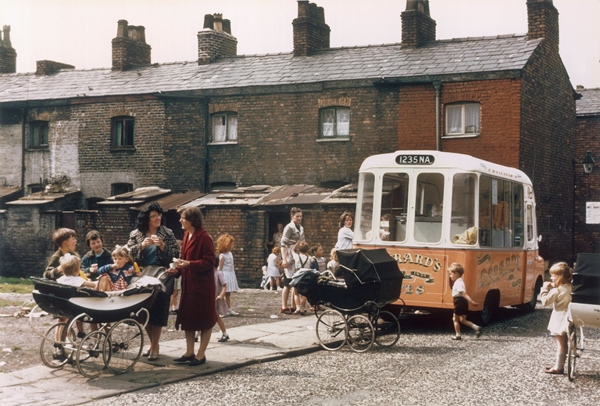
'Ice Cream Van on Terraced Street', July 1965, photography by Shirley Baker, via The Guardian

Nowadays, as contribution to the nation's wealth has been robbed from these people, these former workers' wards/ districts have become wards/ districts of passive - i.e. unproductive - consumerism. This model is replicated throughout our Western societies and this passive consumerism, detached from production and purpose, is the sign of a fractured society. Because having a purpose in life drives you. Having no purpose other than wait for the cheque from the social, while the world is passing you by, is no driver in itself.
 
Meanwhile Shirley's photographic legacy reminds us that there are no rose-tinted ways of viewing poverty, only compassion, through the respectful, non-intrusive intimacy which her eye and lens share with her subjects. It is a social documentary with a heart, the photographic labour of love about a labour force caught in the midst of times achanging.

Looking Back to Look Forward should have been a motto for Council chiefs, private sector entrepreneurs and their acolytes to apply to Manchester for its successful transition into the future, while taking into account the best elements from the past (including values) and the expectations of four generations of the population (from cradle to the grave, if you pardon me the phrase), with the design fitting their lives rather than the other way around. I believe in integrated sensible redevelopment, based on brand-new builds based on classical design, and renovations of designated buildings. I do not believe that redevelopment should require the utter obliteration of the wards.

Further Resources:

Further Reading List - about today's working poor in Britain:
 
Further Manchester Photography: 
The Manchester City Council website is an excellent starting point. The following two resources it lists will provide subsequent photographic information and much more:-

25 May 2016

Elderflower Glory

It is claimed that the oldest memory trigger is smell. One particular example of that experience in my life is everytime I walk by a blossoming elder bush (Sambucus nigra), in Spring. It reignites a nostalgic journey down memory lane. Not only does the sight of this old-fashioned hedgerow favourite and its tiny off-white flower clusters (corymbs) get my full attention but so does the delicate honeydew-like aroma that pervades! Watching with the eyes gets superseded by watching with the nose!


I get closer and bury my nose in the lacy inflorescence and the sweet balmy jasmine-like aroma envelops me into a comforting embrace and transports me back to my childhood days, when my friends and I used to venture on the edge of our small housing estate, eastbound of a sunken path that used to wind down past a bosquet and remnants of pasture and orchard, a surviving testimony of the countryside that was being fragmented into suburbia as my hometown of Saint-Quentin was expanding.

Back then, you could still notice those vestiges of mature, bucolic cottage gardens that were standing still in their semi-neglected state, rife for development in what had become an encompassing suburbia, yet still within walking distance from the countryside. And my most vivid memory is that hedge of closely-knit elder bushes that thrived on an elevation, our perfect adventure ground, vantage outpost and hiding place as kids. We loved it when the bushes were blossoming, less so after the flowers had wilted, and their swollen bases had turned into those clothes-staining dark berries!


Later, life took each of us kids down its wondrous and less wondrous ways, and off a tangent from those dreams and ambitions we had woven under the comforting canopy of those elder bushes. With higher education, relationships, marriage, family commitments, work, milestone achievements, celebrations, and some disillusions, losses and dramas along the way.

I moved 300 miles away from home to University. Then I moved to England. When I did come back to Saint-Quentin a handful of times a year, it was with joy and a pinch in my heart, always to witness things that used to be and were no more, people who used to be and were now gone. One day, I drove down the road and the land where the elder bushes once stood had been flattened. And in their place stood a rendered breeze-block wall that hedged a newly-built property. And that flattened landmark at that very moment defined in my mind the joylessness - and flatness - of suburbia.

Elderflower Cordial by Things {We] Make

Many years later, I found myself reacquainted with elderflower, this time in Britain, my country of adoption. I got to taste their fabulous elderflower cordial, the drink that I have been fondly associating with Albion ever since. Smell might be the oldest memory trigger but sight and taste are a close second!

Elderflower-scented Custard Tart by Belvoir Fruit Farms

P.S: Take the proverbial pinch of salt and read the fun elderflower facts compiled by Belvoir Fruit Farms.

4 Feb 2016

French Design Thrift in the Fabulous Fifties

LBM had been looking pretty until this came along. And I'm afraid we're going to have our noses smeared in it for the good cause, for the beauty-pain paradigm. I had been putting this post off for some reason, and the 60th anniversary of the Grand Ensemble has come and gone, and I am still perusing the topic like I'm meant to be doing something with it - which I am. So here we are now, facing that concrete wall.

In this article, we will explore how the 60th anniversary of the Grand Ensemble last year in France was more a case for commiseration than celebration for its residents and - to a more muted extent - to public authorities and governmental bodies trying to save face and play the political game.

Grand Ensemble de Sarcelles (1955-75)

The failings of the Grand Ensemble are rooted in design and beyond it. If the word 'Design' is supposed to conjure up a divine ratio of style, balance and elegance, seamless execution, quality materials, ground-breaking novelty physique, and is supposed to elevate the collective psyche into a consensus of taste to an idea of grandeur that transcends the physical, then may Grand Ensemble be a slap in the face of design.

First off, what is Design? I shall define it as a piece of Creation that goes to bed with our Emotions. A piece of creation is the alliance of Form and Function - heart and reason if you may - that hits an exact point - the Equilibrium. The equilibrium defines Style. 

The humble clothes peg is a piece of design. So is Taj Mahal. And the guillotine. Design exists regardless of what is considered good or bad, or pretty or unpretty. Because when we start going personal on design, we are putting into play matters of taste. And since you're asking...

Résidence du Parc, Meudon-la-Forêt (1957-62) - (Pict source)

What is taste? Some see the Golden Gate Bridge as metal scrappers delight, while others enjoy how it enriches the landscape, and couldn't imagine San Francisco without it. Taste is personal and subjective, and that makes it complex. It is about Like vs. Dislike. Taste happens, and then it gets influenced, refined, cultivated, sharpened. It evolves, changes even. It gets skewed by peer pressure and the media and the fashion police. There is however a consensus that defines what is deemed tasteful, i.e. acceptable in terms of layout, proportions and overall look - and what is not.

There are different occurences of taste, starting off with what I refer to as 'pure taste' in terms of strict aesthetic merit, which is often applied to Fine Arts. Some collectable and covetable pieces of high-ticket retail finery will be relegated to the design equivalent of Fine Arts status; think a limited edition Aston Martin. But we find that pure taste is hardly practical in everyday existence. So we model taste according to parameters: function, usability, practicability, affordability, etc.

Quartier du Luth, Gennevilliers (1971-73)

Now back to our Grand Ensemble. It was an ambitious post-WWII land planning concept that spanned three decades and revolutionised habitat and lifestyle. It started en-masse in the 1950s* and was conducted on a large scale across France, bringing to the fore mixed-use developments, involving public/ private partnerships for housing, education, retail, office and leisure infrastructures. Architects got on board, ready to embrace a project of a lifetime, caressed to the core by Le Corbusier vanities. The brief was clear: to focus on fast turnover of industrial proportions. Thousands of flats had to be churned out fast (not to say in record time!) and design to be modernist, practical, functional and cost-effective, by all means to the point. It had to be utilitarian, i.e. stripped off the superfluous; understand no adornment. Prefabricated, system-built and modular housing units were the building technique of choice. Quality was secondary to quantity, and matters of personal taste and individuality were off the equation.

Set in its green open space, the Grand Ensemble was part of a bigger picture that took years to roll out fully: transport links (metro stations, wide roads, motorways, and parking amenities). Plus office space, schools, sports centres, youth clubs, retail precincts, libraries, churches and other components of the modern townscape. This would constitute a new town in the country(side), or a new town within the old town, or a satellite town built from the ground up and most likely to be a dormitory town.

Quartier de la Grande Borne, Grigny (1967-71)

The Grand Ensemble was a post-war vision come true - under the auspices of social welfare, sanitation, and city rebuilding programmes - of the luxury of comfort within an affordable life, where each household could enjoy the mod cons that we are taking for granted nowadays: hot water, central heating, modern kitchen, family bathroom, trash chute, and a balcony with a view over a stretch of lawn and maybe even a private garage. The programme was rolled out to working-class and middle-class families, taking them into the Consumer Age in capital letters!

The concept looked good and ambitious on paper, efficient in the book-keeping department - and utopic. Utopic in that it played down the complexities of the human psyche, especially once the mod con honeymoon would start wearing off, and the golden age of consumerism would get dented. Residents and other stakeholders got to write the history of that brand new place, without guidance or support, bringing with them emotional intelligence and complexity (hopes, fears, expectations, etc.), and family customs, and still trying to make sense of that new way of doing things, of making their mark, of living the space, of moving on up within it, of creating a future for themselves, of establishing a community in a forced communal living rolled out on a grand scale.

Cité des 4000, La Courneuve (1957-1966+)

I doubt grand was ever meant to be great. It was meant to be good and do good to a point. It gave mixed results and became a cause for concern. Little by little, insidiously first, the Grand Ensemble lost points; it turned shoddy quickly, it got told off, landed a red mark, got sent away and then assigned to residence into itself. The Grand Ensemble became unloved, uncouth, unkempt. It ended up sliding down that cul-de-sac that got it to skid into ghetto land. It got featured in music videos but not under a good light. It crossed the line and became a buddy to gangsta culture. Some of the architects came out of the woodwork to explain their oeuvre, their expectations of how lifestyle should have been conducted in those unnatural, unorganically-expanded environments.

The Grand Ensemble was an artificial environment: soul-less, with no heritage, no history and nowhere to go. It had been an expedient social experiment, a means to an end meant to immediately solve housing problems and hope for the best. The ensemble had sprung out of paper, out of nowhere, and families from different walks of life and life stages, and with different expectations had got thrown in together at the deep end to make it happen. Residents, now all boxed in together in 'cages' where taste and design had been leveraged to an absolute minimum, if not abstracted altogether. What we got was minimalist as in utilitarian and brutalist, where individuality had no place.

The very first Grand Ensemble ever built harks back to the 1930s: Cité de la Muette, Drancy.

After all, ensemble alludes to a togetherness of collectivism and mass, and that moulding in of the human race, that cookie-cutter approach to life as a singular unit is a failing all to itself. What fails design is when the human factor in all its complexity has been taken out of it, and when design has become clumsy and cumbersome rather than user-friendly.

P.S: All the above-pictured towns are located in the vicinity of Paris.

(*) P.S: A mass-housing scheme had been set up by the French government under a public-private partnership, prior to WWII. Under the Loi Loucheur of 1928, the French government incentivised households to become home-owners, having the house of their choice built with the help of loans at preferential rates. State-appointed architects were tasked to monitor the quality of the builds. Besides, provisions had been made for the (state-subsidised) mass-construction of 260,000 council housing units over five years, under the expertise of Le Corbusier, but WWII shelved the project.

Further Resources:
  • A fascinating case in point in the Grand Ensemble study is Les Espaces d'Abraxas (Noisy-le-Grand, near Paris), a late-bloomer on the Grand Ensemble era. Built between 1978 and 1983 under architect Ricardo Bofill, it has the particularity of being a design-led scheme, which makes it stand out from earlier housing schemes. However life in a design-led ensemble has not been kind to its residents, and soon enough the concrete and glass infrastructure has turned into a carbuncle of dislike. Design is partly to blame as the architect put an emphasis on design for design's sake to the point of making it impractical to live in the buildings, and feel safe in them! A victim of its own lack of success thereof, Les Espaces d'Abraxas (otherwise known as 'Gotham City' and 'Alcatraz') have become a film set of choice for dystopian science fiction superproductions like Brazil and The Hunger Games: Mockingjay - Part 2, as an eery echo to dystopian living on the estate. Who said reality was stranger than fiction?
  • A chillier and more sinister particularity of Grand Ensemble relates to Cité de la Muette, in Drancy (pictured above), the very first Grand Ensemble ever built in France, in the 1930s. However it was used as the Drancy internment camp during WWII, confining Jews who were later deported to the German extermination camps. 
  • 'Souvenir d'un Futur' (Memory of a Future) by French photographer Laurent Kronental is an award-winning ongoing project that captures life as a senior citizen in the Grands Ensembles of the Paris region. A must-see! More from ArchDaily.
  • Rétro-Géographie, a visual log of mid-century French architecture. 
  • The Age of Instant Architecture by The Independent.
  • LBM's musings on style and lack thereof.

7 Jan 2015

Freedom of Speech - Forever Charlie Hebdo

Visuals are powerful and impactful means of communication. As pictures, cartoons, illustrations, graphics and other forms of visual expression, they are each conveyors of a thousand words, emotions, actions, messages, ideas, wit, humour, innuendo, controversy, that words fail to express in one instant, one shot, one swoop. A French scandal magazine by the name of Paris Match even made the tagline "Le poids des mots, le choc des photos" (weighty words and shock pictures) its trademark - with an ambiguous play on the word 'weight'. Meanwhile let's just pause for a moment and try to figure out the likes of Life magazine and National Geographic without their image stock. This is simply unfathomable.

The power of the internet has from the start capitalised on the power of images (increasingly at the dispense of words), and social media have harnessed their success based on visuals, a perfect fit to wordless transmission, culture on the go and 'live in the moment' inclination. From the advent of the printing press, satirical magazines like Punch and Le Canard Enchaîné have had a field day with cartoons, building their readership around them. Charlie Hebdo did this too, with its star cartoonists Wolinski, Cabu, Tignous, Honoré, and of course Charlie's chief editor Charb.

Charlie Hebdo (pict source)

Since day one of 1970, Charlie Hebdo has been flirting with controversy. Then again, isn't controversy the one-size-fits-all word used to describe the free-thinking members of society, defenders of Free Speech and Free Press? Charlie Hebdo shot its poison arrows in all directions though, with no affiliation to a political party or faith or creed or line of conduct, just depicting the world around us with a streak of - sometimes acute - sometimes oblique - attitude, objectivity, sarcasm, derision, mostly turning to ridicule anything that took itself too seriously and imperiled freedom at large, democracy as a whole, and republican values. This cost Charlie dearly.

With this obituary cartoon by Charlie to Charlie, La Baguette Magique herein self-proclaims to be one of Charlie's guys ("Je Suis Charlie"). By slaying on this very day 12 people at Charlie's HQ and whereabouts, the terrorist low lives that take themselves way too seriously shot our already ailing Freedom of Speech and Freedom of the Press but they will not sentence them (us) to silence! Meanwhile the ultra-polished, ultra-sanitised politically-biased media brigade that deliver the news should shut up instead of yet again missing the point with their silly verbiage and pretend affliction.

Charlie Hebdo (02 Nov 2011)
Charlie Hebdo (03 Sept 2013)
Charlie Hebdo (29 Apr 2014)
Charlie Hebdo (16 Sept 2014)

24 Jul 2013

Inspire Aspire - Vivienne Westwood

Her eccentric style and sometimes far-fetched creations mean that she may not be everyone's cup of tea, but Vivienne Westwood is certainly a cut above fashion glitterati! To her credit, she has inspired countless designers and artists in the making to go off a tangent to explore their passions rather than follow the mainstream avenues of formal education in order to get a foot in the door and get noticed. And to me, this is all down to one word which has been a driving force for the fashion darling.

(Pict source)

I remember quite vividly watching a fascinating TV documentary back in England a good four years ago. I found it enlightening and inspiring, to the extent that four years on it still plays in the back of my mind whenever I harbour a doubt as to my next direction in life, and whenever I try find a reason why I can't make it.

Casually and very humbly, Vivienne mentioned a couple of times during the programme that she was self-taught. Yes that's right, a self-taught fashion designer and seamstress. She wasn't fresh out of Central St Martins College, and she didn't have the family connections to get that red carpet out and ease that ambition up into the fashion circles. The woman who famously said: "I didn't know how a working-class girl like me could possibly make a living in the art world" thought outside the box. She came from punk, she came from that clothes shop on London's Kings Road outrageously called 'Sex' where she designed crazy outfits for the likes of The Sex Pistols. As far away from the lofty French fashion houses in Paris VIII as can be... And the irony of it all would be that years later those very same individuals who sniggered at her origins would cram up into her fashion shows and shell out the dough.

Anglomania Collection - AW2013-14 - Look-091

To some, self-taught might mean a roundabout last chance saloon way of getting from A to B. To Vivienne, it was a successful means to an end, where theory was experimented upon, fun was had with swathes of fabric, where ideas could just flow without the restriction of dos and don'ts, and opportunities seized in a 'right place, right time' mode. Carpe Diem. Self-taught is the best out of the school of life. And closer to us, self-taught has seen bloggers turn household names and YouTube sensations set up shop very successfully, and I can't resist the thought of this other self-taught guy - Sir Richard Branson - the very boss of the airline company whose flight uniforms are being designed by our Vivienne. How ironic indeed!

10 Jan 2012

Ill-Fated Journeys (Part 3)

When you get caught in crossed-wire situations and control - otherwise described as the grasp one has over their life and destiny to an extent - escapes you like a spagghetti down the plughole, things start playing on your mind. Things you wouldn't normally give a second thought to, as the mind has the power to cloud your judgement and make you start believing in the unbelievable. In my case, not only did I rightfully feel totally powerless, I also started to believe my mate and his posse had conspired to ditch me for whatever reason so they could enjoy the party - and not my company (of course!). Miaoww, get those claws out pussycat!

Edward Hopper, 'Nighthawks' (1942), via The Artchive

So then, in the face of adversity what was I supposed to do? Brave the deserted streets in search of the bars, ask around, wait around, stomp around, ring back my mate and leave pointless voicemails? Or lock myself in the car and keep schtum until I get a sign about the party coming magically from somewhere anywhere? Have a sob, wish the night away and take forty winks while I was at it? What would you have done?

There were no two ways about it as far as I was concerned and I had to make a decision pronto as I had no intention to spend a solitary night in Corte. I wasn't going to track the bars and traipse down them lonely streets in search of a birthday party whose very existence I was seriously questioning by then... I wasn't going to play a game of bravery, stretch my patience any further or wait for a miracle. I regained control, took destiny into my own hands, only after I had weighed the pros and the cons and sighed some more and shaken my head some more. In the rear view mirror I checked some sinister shadow gliding past me and that sealed the deal for me.

Ikko Narahara, 'Engraved Arrow, Arizona' (1972), via Galerie Priska Pasquer

I fastened back my seatbelt, turned on the car key, manoeuvred off my parking space and drove off into the cold Corte night. A few hundred yards down the road I spotted a petrol station with a caff, all lit up, with a bit of life coming from within, and half a dozen 4x4s parked outside. I stepped in, asked for a coffee and one of those packaged madeleine cakes, while I was being inquisitively eyed up and down by half a dozen country folks in hunting gear drinking beer and playing cards.

Something made me think about Edward Hopper's atmospheric 'Nighthawk' painting and I stopped feeling sorry for myself. I necked down the gritty inky coffee, stepped back outside, braved the night and embarked upon my two-hour journey home across the mountains, down the sprawling plains and up the more familiar coastline. In the middle of the night my phone bipped and this somehow woke me up but I felt neither the need nor the temptation to check the message.

By then it didn't matter to me anymore what the reason might have been - if a reason there indeed was. Some journeys are simply meant to be a driven introspection that puts you in touch with your higher self.


19-May-2016 Update: Let your exploration of Edward Hopper's creations be the start to a fabulous journey into the world of Fine Art, thanks to Artsy, the leading online resource in art collection and education. Artsy showcases a comprehensive compilation of Edward Hopper's art, including his biography, selection of his works, exclusive articles and up-to-date exhibition listings, in a visually-enticing form. Enjoy the journey!