Showing posts with label recession. Show all posts

16 Feb 2018

The Deconstruction of the West: A Warning

Turbulent times afoot! Is our fast-changing world changing for the better? Does your past suddenly embody 'the good old days' and you're starting to sound like your grandparents while your kids haven't even started high school yet?! You are not alone on this. It is getting increasingly clear that the deconstruction of our modern Western civilisation has been masterminded from way above, by the nameless, faceless upper echelons of the multi-layered cake that symbolises the intricate hierarchical global governance nerve centre whose scope of influence and decision-making via institutions, institutes and foundations criss-cross regions, nations, continents, faiths and cultures in ways unfathomable by us the commoners. Yet it appears that a warning of things to come had been intimated as far back as 1969.

Minotaur, gypsum sculpture by Emil Alzamora (2006) (pict source)

If you are in your forties like I, you will have enough scope to be able to draw up a rough comparative study between what you remember from your childhood years in terms of societal environment and the way society has turned out to be. Your elders will probably have brought enough food for thought to you through observations of their own. Compared to my early experience of it, I do not recognise the West - and this I say without exaggerating.

I had noticed a shift (although I couldn't formulate it at the time) as far as the early 1980s, when disindustrialisation became prominent, and the textile, steel and coal industries were blitzed out of existence from their production centres. I witnessed it first hand in my French northern textile hometown of Saint-Quentin. And it became increasingly apparent that political figures all the way up to the President had been complicit in the demise and let those production towns down like a bad memory: they saw them as an embarrassment. We were silenced, urged to get used to it sooner rather than later, there was no turning back. And when I say let down, I mean a total collapse of the local economy and high unemployment rates (20%+) as a direct consequence, that shot up almost overnight. The powers-that-be coined a word, a magic word, that would explain it all and reassure us, and most importantly which we could blame for all our misfortunes: 'recession', the new normal.

Model: Cloud, sculpture by Maggie Casey (2006)

Oh, the governmental bureaucrats, business analysts, poncey economists, know-it-all journalists - and even your own boss or auntie Céleste after hearing their lecturing speech on the telly - wouldn't leave it at that. They shifted the goalpost. They pointed the finger at the unemployed and the soon-to-bes. Those were the culprits! They were criticised for having been too greedy, for demanding less working hours, better working conditions and higher standards of living. Can you believe that it was ultimately their fault if the factory had to close down altogether or relocate its operations to the Far East?! They had to pay the price and fellow countrymen became divided over the hot topic. And the bureaucrats nailed their despise for the Labour Force further by accusing the French of shunning factory work like it was beneath them. That only foreign, emigrant workforce were willing to work on the assembly lines now. Another fallacy and a sure dividing point that would fracture further the nation. 

Rule of Thumb No.1: Divide and conquer.
if you seek to rule, create division and chaos.

During the 'recession', swathes of working- and middle-class took a hit and lost their jobs before they could even save for a rainy day. Those who yesterday (i.e. after WWII) had rebuilt the country up now found themselves in forced redundancy. They became redundant from work and from life. They were forced to exchange their usefulness, their skills, their craft, their trade, their experience, their diligence, their dedication, their pride, for a cheque from the government. Forced to leave their neat little semi-detached whose mortgage they could afford no more for the 'joys' of subsidised housing, stacked up like unwanted goods on shelves. They had become unwanted goods. Now they had to learn to become invisible.

Public-private partnership agencies mushroomed out of the woodwork. Those were supposed to come to the rescue of the unemployed. All they did was skewer the job statistics by shunting them from one category to another, through retraining schemes more akin to a brainwashing session to realign their psyches so they became acceptant of their fate, and live by on governmental aid and be thankful for it. The industrial West was becoming a thing of the past. The skilled guipure operative was urged to retrain as a supermarket shelf stacker. And her husband, formerly a steelworker, to do part-time pizza delivery. That's where the demand was at.

In my life journey, I have come across much wasted talent, countless wasted lives, lives that could have accomplished but whose talents were stunted out of existence or side-tracked. Graduates like I who didn't want to end up on the dole had to export themselves overseas for work and not be choosy. Is this the way for a nation to operate? Waste its homegrown talent away or force it out of its borders?

Encyclopédie de la Vitesse, Editions Hachette (1956)

In the Western society model, strong precepts had prevailed until the 1960s/ 1970s. In France we had a glorious moniker for it: les Trente Glorieuses, three decades of full employment and buoyant economic activity (approx. 1945-1975), boosted by the aftermath of WWII (reconstruction) and the move into the consumer-centric technology-savvy model, a boon!

This was held together by an unshakable moral, socio-economic code of conduct. Back then, our society structure would put strong emphasis upon the Nation State: civil rights and civil duties, undefected pride in one's nation. Patriotism was embraced unconditionally, not derided.

No knees were taken when the national anthem played: 
you stood up and honored the fallen and the living 
under one flag!

Respect for Law and Order was tantamount to a functioning society, where the State ensured the protection of its people and the people paid their respect through national identity and pride, and served their Nation when national security was threatened (war). Rights and obligations of the people towards their Nation and of the Nation towards its people, a strong economy and buoyant industry sector, with wares manufactured locally/ nationally. All of these concepts, still prevalent in the 1960s, incrementally deliquesced to the point that they have now been turned on their heads.

Family and religion were still strong in the 1960s/ 1970s but the communist, marxist, trotskyist, socialist, atheist, feminist and other activist movements did not help the cause; if anything, they fragilised it. In fact, neither do they unify nor pacify: they instead harbour division and disfunction. Bingo, all that the elites want!

As we are getting more enlightened to what really is happening to us and refute the mainstream media's fabricated truths, we come to the realisation that the economic decline of the West as we view it today had been orchestrated all along. And some of the evidence points out as far back as 1969 with Dr Richard L. Day's infamous speech. His 'predictions' turned out to be accurate.

18 Sept 2017

Aerial Views of Bygone England

In order to visually grasp in one quick swoop the extent of Britain's heavy industrialisation during the 1920s (notwithstanding the fact that the bulk of its Industrial Revolution had already been through by then), seek no other evidence than photographic - and better still the aerial shots! Britain from Above has made this possible, not only for institutions and corporations but also for the general public, by releasing its impressive photographic archive collection (over 82,500 records for England alone!) which provides the tools for a spot of investigative geography and history, right from the comfort of your home. And fascinating it is bound to be to anyone with a connection to Britain and curious to discover the face of its past!

Beswick, Manchester (1927), via Britain from Above

Second to none, Manchester was once my second home; I spent 16 years of my life there. Naturally as soon as I came across Britain from Above, curiosity got the better off me and I sifted through Manchester's photographic records, seeking the familiar neighbourhoods I had lived in and semi-familiar environs which I had travelled through, worked in or visited for one reason or another. Needless to say that present-day Manchester bears little resemblance to its bygone self, bar for specific landmarks: town hall, churches, flagship stores (the Lewis's department store, now Primark), canals, railways, certain roads and playing fields, and the odd pub here and there that has survived the accelerated nationwide 'pub cull' of the last 20 years.

As shown in the Beswick ward above, like elsewhere throughout the working-class areas of the city radiating right out of its centre, row upon row of identikit 19th-century brick terraced and back-to-back factory houses used to be tightly laid out, taking up every inch of available space for cheap low-rise high-density working-class housing - which was turning to slums by the 1920s. Nineteen thirties Manchester was a crowded place; its population had peaked at 766,311 inhabitants in 1931 before steadily shrinking, in line with the collapse of the textile and affiliated machine tool industries, down to 404,861 by 1991, a massive 52% fall in numbers within 60 years! By 1991, the slum clearances and industrial wastelands were lending a surreal urban landscape, especially east (Ancoats to Ashton-under-Lyne axis) and northeast (Cheetham Hill to Oldham axis).

Ordsall Hall Paper Works, Pomona Docks and Manchester Ship Canal, Old Trafford (1929), ibid.

From such a bird's eye view, from such a height, with eveything appearing like distant patterns dotted upon a canvas, it is all too tempting to feel nostalgic and gloss over a time period that was actually anything but kind and sweet. Although full employment was on - except during the Great Depression, it still came at a price, even by 1920s standards: harsh working conditions, long working hours, low wages, poor health, cramped and unsanitary living conditions, not to mention the smog, a deadly combination of smoke pollution (from factory and domestic coal burning) and fog, creating pea soup, which plagued industrial cities with a thick yellowish toxic shroud, bringing asthma and other respiratory ailments and drastically reducing visibility.

Manchester Ship Canal and Partington Coal Basin (1929), ibid.

Furthermore, the nation was still recovering from the throes of WWI, where 23,792 men and women from Greater Manchester alone had lost their lives on the front! Extrapolate this to the number of households affected by loss, the mothers, widow(er)s and orphans, the harsh economic reality of daily life sharpened the grief some more. You can be certain that the photographed households you are looking at are testaments to pain and hardship.

Manchester's cityscape is industrial no more! Photography by Daniel Nisbet, 2008, via Flickr

Further Resources on Manchester and the British Industry:

22 Feb 2017

Transience, Pillar of Modern Society (Part 3)

Transience is supposed to be a temporary, transitory stage, yet we shall see in this third and final part of my essay how it is being made to drag on so as to become a permanent fixture of modern society. Transience applies geographically and figuratively and relates to transition, waiting for a change to manifest one way or another.

Transience is a state of limbo that occurs somewhere between a departure point and a destination point when events are fluid and uncertain. It summons aimless errance, perhaps drifting, with an element of waiting for circumstances to change for the better. It is the state of not knowing what's next and not belonging anywhere in particular at a moment in time and for whatever reason this might be. There are no roots to transience, no anchorage. It is the free agent for change, hence for uncertainty and unpredictability. It belies a period of unstability.

Lockheed JetStar and the 1960 Lincoln, via Plan59

I have identified herein five transience-generating areas within our modern society. The list is not exhaustive: -


 *  Paradigm Shifts:  Our governments, in cahoot with the media and corporate elites, have upped the ante to engineer a generation or two of confused kids (a.k.a. snowflakes): dumbed-down propagandist education system, gender theory, reinterpretation of the family unit, weakening of Christianity, radicalised angst-ridden feminism, political correctness, forced multi-culturalism, the sharing economy, and other paragons of humanist (undertand socialist) ideology jar with traditional homogeneous family values in terms of tradition, culture and history. We witness societal confusion, a shift in points of reference, landmarks sliding away. What used to be held in stone, held as truth by our socio-political system has now been questioned, deemed untrue. Reciprocally what used to be considered a lie is now held as truth: a fluid set of rules!

Under European rule, Europeans are getting the feeling of not belonging anywhere anymore, not to their own country that they do not recognise as it is losing the characteristics that used to make it unique. Their national/ federal government is alien to its people and to the voice of discontent. Europeans do not feel allegiance to Europe either. They feel distrust towards this unelected body ruling unilaterally over a conglomerate of countries bundled up together due to our close geographical proximity. We are all under the ludicrously remote, faceless, authoritarian governship of Babel (I mean Brussels).

This forced Europeanism on its way to the larger picture of globalism is a representation of transience. It stunts our organic growth as individual countries and puts us in limbo.

Labour to leisure: Parc du Haut-Fourneau U4, Uckange, eastern France

 *  Depressed Economy:  When jobs have been forced out of our Western nations to the Far East en masse - as a result of our governments' over-regulation, corporate taxation and other economic burdens, companies have restructured and fierce competition has increased, the job market gets tougher and job security weaker. Lucky is being left with an entry-job for life (i.e. no or little scope for promotion and a career) and the general dead-end retail/ service jobs that keep you on minimum wage for the duration of your working life (white-collar poverty).

Employment opportunities are scarce across all age groups, including those over-qualified graduates. You live in fear of not finding a job, being unable to keep it, ending on the dole, failing to make ends meet and falling onto hard times. There is no self-sufficiency, no financial independence in the picture; loans, mortgages, debts chain you down further. When unemployed/ on low pay, the State takes care of you with little subsidy it provides, putting you in that shadow category, outside the world of workforce. Volatility in the workplace and the depressed economy translate a lack of durability; retail shops open and close fast. The retail institutions that have survived one generation are becoming a rare commodity.

Lack of self-sufficiency, no sense of belonging, constant fear and discomfort are by-products of transience.


 *  Planned Obsolescence:  This good old trick that kicked in with Henry Ford in the 1920s is what keeps the production/ consumption machine oiled up to the hilt. It goes hand in hand with the fickleness of fashion and fast-moving trends that play right in the hand of disposability, and genuine technological progress whose pace has accelerated in recent years. Shorter lifespans and shelf lives, and little to no staying power... Even couture designers like ex-Dior's Raf Simons are burning out, complaining about the frenetic pace of the catwalk and fast turnover of fashion collections.

When you are on a constant move and feel you are playing catch up all the time, this unanchored, unsettled state is called transience.

Spend, spend, spend! Gucci Spring Summer 2017 Set, via Gucci's Instagram account

 *  Transhumanist Agenda:  Transhumanism is the science that correlates human and machine via AI (Artificial Intelligence). It demonstrates how technology is set to benefit us by increasing our mental, intellectual and physical performance with bionic aids, and in certain ways triggering our brain to think like a machine. Multi-lingual websites that are machine-translated subtly but surely show a facet of the transhumanist bias.

Transportation, media, telecommunications and information technology have transformed our lives beyond compare over the last 30 years. Meanwhile social media, a relatively new kid on the block, has already deeply changed our ways of communicating and interacting with others. Besides the treatment of information has taken on a strong transience bias. Instant messaging/ posting puts you right in the moment for the moment. The present has a very short, fleeting - even fickle - window of operation and lifespan. Through our technology-driven communications, we are bombarded with so much information that our attention span is continuously challenged and titillated by other facts to consume fast without time for a thought. We end up being present within a very short timeframe before being challenged and veered off a tangent again. Not forgetting the idiosyncracies of technological progress that keep us on our toes: constant updates and upgrades, forcing us to forever having to adapt to the latest version of an app or programme. This may be a given if you are a teen or young adult, less so for your parents and grandparents!

We are literally drowning in an-ever expanding sea of news, visual distraction and solid ambient noise. Information is fed through technology, at the mercy of it being tampered with, manipulated, updated, upgraded, unplugged. Transience is right at home there!


Interstate 30 East of Dallas, for Portland Cement Association (1960), by Stan Galli, via Plan59

 *  Emperiled National Sovereignty:  Open-border policy and its resulting engineered mass migration is the thorn in the side of the West right now. It acts as the wide-scale resettlement of an uncapped number of individuals (in their millions) allegedly fleeing war-torn, poverty-ridden countries (otherwise classified as emerging countries, Third World). They are essentially relocated to Western countries, which are economically richer, deemed politically stable, and with a welfare system in place.

Migration is a spur-of-the-moment, open-door policy that prides itself in being unchartered - and seemingly unregulated. The modern day migrants are mostly driven, angry young Muslim men, wearing fashion attire and technology-equipped. They land upon our shores with an erased past, a low IQ, high expectations and no expressed desire to integrate. No proof of ID required (which would technically have them qualified as illegals or refugees except they're not), and not a penny to their name. I shall add:-

When you erase someone's history, you undress them from the riches and depths of family, tradition, heritage, culture, self-worth, identity. You uproot them, cut the anchors. You isolate them from their true self. Someone without history is not free and grounded; they are transient in their body, mind and spirit, on a quest to find out their origins, their true selves. When you erase their history, you are left with a blank canvas. You may rewrite it for them, remould it as you see fit. This doesn't serve the individual, it serves the global agenda, which is all about short-term memory, superficiality, and transience.

This incentivised mass population relocation is coordinated by a plethora of super-connected NGOs and not-for-profits financed by benevolent philanthropic elite corporations and tax-exempt foundations (The Bill & Melinda Gates Foundation, The Ford Foundation, The Rockefeller Foundation, The Clinton Foundation, George Soros's MoveOn.Org and Open Societies Foundation, etc.). What have they in common? They are New World Order and work in unison for a global socio-economic and political model that will fathom a rootless, pastless and futureless populace living in the moment for the moment. Transience in all its grace and glory!


Dissected/ Distorted reality? Matrix LED Screen, via MoMA Store

This forced multi-culturalism of sorts that is being expedited under globalisation personifies transience in modern society. It shakes up by its very essence the host countries' fabric in terms of republican, secular and religious values, national identity, safety, homogeneity and unity to the core. Regardless of political affiliation, one must admit that migration in its current high numbers is not sustainable, and neither is this extended transience in itself. Meanwhile the natives feel invisible and unheard, as all sorts of eccentric, unreasonable demands are placed upon them by their increasingly undemocratic governments, in order to force them to surrender their nation to the global agenda that lies ahead, as the EU is increasing its governance over our lives - and we have no word in edgeways on the matter.

As for us indigenous populations of the West, we have to be/ remain mobile - transient - within our own countries, for work or personal purposes and it could take most of our adulthood before we are finally able to settle down in one place. Rural exodus is not a trend of the past. After peaking through the Industrial Revolution and the 20th century, it is set to carry on depleting the countryside. As a direct consequence, cities are soaring, a trend that is encouraged under Agenda 21. This uprootedness is symptomatic of transience.

"Man without history, culture, nation, family and civilisation is not free: he is naked and condemned to despair." - French Canadian sociologist Mathieu Bock-Côté (translated from French)

P.S: Note the difference between migration and (legal) immigration. Legal immigrants move from their country of origin or residence to a new specific country where they settle down with their family. There is an immigration protocole for them to follow in order to become part of the local society: for example, visa, application for residence and Green Card if in America. On the other hand, migration is an open model of immigration without a roadmap or demand, uncommitted to responsibility, including that of integration, and who whimsically follows the pick-and-choose-a-country formula as it is presented to them. Migrants are the no-history, no-fixed-abode and no-fixed-destination travellers with the risks that such can bring: social misfits, drifters. Note the Houdini trick here: illegal immigration has been cleverly merged into migration. This legalises and legitimises illegals instantly and automatically (cf. Paradigm Shifts section).

P.P.S: Nomadic tribes are not technically classified as transient because their nomadism is a pillar of their society structure. They have a history, culture, way of life that revolves around travel, follows a specific habitual pattern, in relation to seasons, transhumance (seasonal migration of herds and humans from lowlands to the mountains), customs and traditions, availability of produce, and trade. Their nomadism is no aimless wander.

The steady unrelenting erosion of national sovereignty paves the way for globalism, a paragon of transience all to itself as its aim is to level down all countries to a pre-made model, where we will be formatted to think the same, speak the same, dress the same, live the same, behave the same and essentially be the same. This Orwellianism has become a feat of realism as it is already happening right before our very eyes. History is erased or constantly readjusted: yesterday's truth is today's lie.

_________

Transience, Pillar of Modern Society is a 3-part series:  Part 1  |  Part 2  |  Part 3

21 Nov 2016

I See You Reaping What You Sow

The time machine has whimsical ways to whizz you down tracks unchartered. How about take you down to rural Cambridgeshire, England, in the height of Summer 1938 just in time for the harvest? Put your straw hat on and follow me!

Farm Crops in Britain, illustrated by S.R. Badmin (1955)

In my personal quest for cultural heritage, national identity and the kinder ways to nature, I came across a short documentary (cf. end of post) currently listed on the homepage of Common Ground, a British charity established 33 years ago, and whose founders 'seek imaginative ways to engage people with their local environment.' An interesting mission statement which I am trying to apply here in my own modest way and out there, in the real world. Common Ground's England in Particular on-going campaign describes itself as 'a counterblast against loss and uniformity, and a celebration of just some of the distinctive details that cumulatively make England.' How charming, I'm in!

I was kindly referred to Common Ground by Philip Wilkinson, after I left a comment a couple of weeks ago on his award-winning architectural blog, English Buildings. In his informative blog, Mr. Wilkinson - an advocate of heritage preservation - partakes of anecdotes and photographic evidence of architectural gems from his locale that stand tall and proud as exquisite pieces of British quintessence.

ibid.

Buildings are inanimate objects, yet would it feel out of place to claim that they grace our lives with their presence? Their presence because they exude grace and charm and sobriety - or eccentricity - and other facets of interest that confer the weight, the presence, the personalisation that gets them noticed. They hold memories and figuratively have a soul. This presence you get from those older structures you simply won't get from the new. Such buildings are still part of our landscapes, whether thanks to a heritage preservation act, or the loving care of their owners, or out of sheer lucky fluke! Whatever the circumstance, they each challenge the uniformisation agenda that globalisation is promulgating under its worldwide takeover of our geographical, architectural and cultural landscapes.

The founders of Common Ground refer to national and local particularisms as local distinctiveness, which embraces both material/ physical heritage (architecture, design, infrastructures, materials) and intangible cultural heritage (processes, craftsmanship, techniques, way of life, celebrations, folklore, customs, oral traditions, dialects).
Here in Corsica, I witness first hand how the local distinctiveness in terms of architecture, crafts and design is fragile and endangered to the point of no return. Coveted, despised, uncared for or downright neglected, it falls foul of good intention. It ends up plundered, reinterpreted or altogether destroyed


For a ravishing recording of a way of life (on the wane), I invite you to view the English Harvest documentary (brought to us by BFI). It showcases a delightful visual treat of a portrayal of idyllic country life set in bucolic rural Cambridgeshire, and features harvesting and cultivation methods past. A bygone era that was laborious, ordained, organised, well-dressed and prim and proper. A time of rural thrift and hardship nonetheless, with WWII looming on the horizon to crash it all down. Yet this was a time when man and nature were still close, standing in communion and in unison.

Today our farmers have all the chemical warfare under the sun at their disposal, the machinery and the technology, not to mention the long stretches of uniform land for ease of manoeuvring. And yet their lives still teeter on the edge of poverty, crushed by the long working hours to scrap a living, the relentless bank loans that keep them artificially afloat in the moment and the burdensome bureaucracy of rules and regulations, notwithstanding from our non-elected EU Babel Tower over in Brussels.

ibid.

Add to this a malaise that is running deep, exacerbated by unrelenting mass consumerism that operates on low production cost demands and high corporate profits for the multinationals, and life as a farmer slides down an ever-shrinking - almost elusive - bottom line.

The modern farmer's life is short of servitude. The irony of it all is that his family land feeds the world while leaving him and his kids in the lurch, on the thrift side of a good hearty meal, and worked out to an early grave.  The farmer will be crying in his barn - out of sight out of mind - like his cattle taken to slaughter after they gave it all for no or little recognition.

The land still beats to the tune of his elders' heart, but the song is adrift with the mortal whiff of weedkiller and fertilisers, his mortal coil to be. Under this current relentless paradigm, the land is dying and is killing the farmer, when all he wanted was to live off the land he loves.

6 Nov 2016

A Vote for Donald Trump WILL Save the West

There are no two ways about it, folks... Donald Trump as President will not only save America but the whole West from the web of corruption brought about to destroy us!

On the other hand, a vote for Hillary Clinton is a vote for the New World Order, global elites, NAFTA, TPP, TTIP, mass-immigration - and World War III. A vote for Crooked is a vote for a jobless, subservient, open-border, Agenda 21-compliant society; a vote for the loss of national sovereignty and for the finalised collapse of the West. American friends, think carefully before you cast your vote. This election is the most important of your entire life and the future of the West depends upon you.

(Pict source)

Transcript for “Donald Trump’s Argument for America”:

Donald J. Trump:

"Our movement is about replacing a failed and corrupt political establishment with a new government controlled by you, the American people.

The establishment has trillions of dollars at stake in this election.

For those who control the levers of power in Washington and for the global special interests, they partner with these people that don’t have your good in mind.

The political establishment that is trying to stop us is the same group responsible for our disastrous trade deals, massive illegal immigration and economic and foreign policies that have bled our country dry.

The political establishment has brought about the destruction of our factories and our jobs as they flee to Mexico, China and other countries all around the world.

It’s a global power structure that is responsible for the economic decisions that have robbed our working class, stripped our country of its wealth and put that money into the pockets of a handful of large corporations and political entities.

The only thing that can stop this corrupt machine is you. The only force strong enough to save our country is us.

The only people brave enough to vote out this corrupt establishment is you, the American people.

I’m doing this for the people and the movement and we will take back this country for you and we will make America great again. "

13 Aug 2016

Driving Motown Back on Track

Detroit's road to recovery will need more than a Berry Gordy song and the pep-talk speech of a presidential candidate but big things start small. Detroit stands forlornly like a forcefully doomed industrial Gotham and has become a purveyor of choice to the Urbex back catalogue.

Once hailed as Motor City, the Michigan automobile heartland revolutionarily put wheels on America and made it mobile and packed its car radios full of smoochy love songs that engendered the next generation of Americans. But the city has long lost its manufacturing panache. Trouble crept up in the late 1950s with the closing down of the Packard Motor Company, already a sign of the restructuring automobile sector, and trouble never left town. Detroit has now become the stuff of nightmares: a major redundant ghost city potholed in limbo, lumbered with high unemployment and poverty rates slammed against a high exodus rate, resulting in thousands of empty, unsaleable private properties and public amenities crumbling away with neglect and the passing of time.

Flower House Detroit installation, 16-18th October 2015

It is difficult for someone like me to remain indifferent to the human, economic and historical tragedy of a city like Detroit. By the same token, it would be easy for most to look away and drive past and write it off with the strike of a pen, which is exactly what has already been done when the city declared itself bankrupt in July 2013. Yet rather than look at it as a town doomed to decay further, some - mainly artists and visionary entrepreneurs - see it as a sleeping giant waiting to be jump-started back to life, with sorry looks, decrepit figure and raw talent to be capitalised upon.

In the political realm, it would be easier for a presidential candidate to bypass Detroit and aim for sunnier climes and shinier streets than chance stopping over to address an audience of would-be voters in a once Democratic, Trade Union-led, working-class stronghold. You would also have to pen a speech - because in its current state of abandonment, Detroit would indeed require a tailored speech. Donald Trump and his VP acolyte Mike Pence hit the brakes nonetheless and stepped in. The Republican candidate never shies away from a challenge and his speech in Detroit was invigorating and well received. It stated the stats and packed the punches. But above all, it put Detroit firmly back on the (road)map. Trump believes in Making America Great Again (his motto!) and with employment his utmost priority, as with Americanism over globalism, the billionaire businessman aims to address full-on the rigged economy that has laid off American manufacturing in its swathes, and he has vowed that the renaissance shall start in Detroit.

Flower House Detroit ibid.

I believe in purpose, I believe in work. I believe in a country that is industrious and autonomous, with a strong economy, and relies on homegrown: strong agriculture and manufacturing base. I believe in a government that is non-intrusive and empowers its citizens through free enterprise and the spirit that goes with it. I believe in minimal bureaucracy and lighter taxes. I believe in hope and faith and dream and opportunity and feasibility for all. I believe in quality education and those good old-fashioned Christian family values. I also believe in Law and Order and national sovereignty. Detroit, America and the West at large have long been forced to relinquish what used to make them functional and prosperous, and there they are now - to different degrees - shadows of their former selves.

Like Mr. Trump I have faith and refuse to accept what current governances are forcing us to accept as inevitable: widespread unemployment, low-paid ungratifying jobs, large-scale imports, foreign takeover of national ressources and assets, warmongering politics and meddling into the Middle East affairs, and redundancy of talent and creativity in order to fit the tight uncomfortable mould that we are being forced into by the oligarchs. I believe that Detroit can and will resurrect under a constructive, populist, work-centric governance. And I might as well say it with flowers... because big things start small.

Flower House Detroit ibid.

14 Jul 2016

The Dawn of the European Superstate is our Doom

If you are a world supremacist wannabe looking to build a superstate, look no further than the European Union for inspiration. In order to construct the European Union behemoth, warts et al, you have to deconstruct each and every country that is a component of the so-called unity. To achieve this, you need to deconstruct national sovereignty in order to construct the so-called European sovereignty, an unelected sovereignty deeply entrenched into the Agenda 21 principles. Welcome to the globalist dystopia that is being put in place!

'Athena', fantasy art by Cynthia Sheppard

First off, in order to deconstruct national sovereignty you need to tone down national identity. Then amalgamate national pride and patriotism with fascism and racism, which has been going on in France and elsewhere stealthily for the last 35 years. This is key to undermining the strength of a nation. Once national pride has been cleverly associated with fascism, it is put down, and the orchestrated erosion of national values triggers an open-door policy for imports (goods, services and investments, hence cash-flow). The same applies to people (mass immigration), ethics, views and politics that get unified under a fake right/ left, right/ wrong, rich/ poor, black/ white paradigm. Alongside this, in order to construct a European unity, you need to deconstruct unity at its cellular level (family unity, race unity, national unity, etc.).

For European unity to exist under the globalist model, expect no elevation of spirits and values and quality of life. Expect no flourishing prospects in terms of wealth and prosperity, education, employment, trade, industry or philosophy. Expect the exact opposite. Any sensible individual capable of reflecting upon current affairs, will have realised by now that each of the countries that make up Europe is in serious trouble. I acquiesce to this with all my while, having lived in the thick of the 'Union' all of my life, and long enough to realise that things are not adding up in favour of growth, but in favour of ungrowth. We Europeans live its absurdities with every breath we take. You will therefore have to excuse our dulling joie de vivre...

'Momentum' by ibid.

Distractions might take the unguarded off course, as for instance with the Anti-Brexit millennials who took to the streets of Britain on the aftermath of the referendum berating the 'old white people' that they wish would die, including - I imagine - their grandparents? But let's not be fazed; Paul Joseph Watson got it debunked for us in less time than it takes for a pop song to play.

Socialism, otherwise known as the Liberal left, the Democrats - or in more gauche terms as Tony Blair's New Labour - have made Europe their hotbed. And wherever socialism goes, ungrowth follows, all under this forced collectivism and communitarianism, multi-culturalism and other '-isms' and chasms that the individual is forced to surrender to... Here are a few examples:-

  • Private liberties are being eroded.
  • Political correctness paralyses free speech and makes us all potential suspects; it prevents politicians and other people in the public eye from expressing themselves without having to justify a word in lengthy ways.
  • Burdening through over-taxation, over-bureaucratic nonsense, over-politicisation of public and private life with our puppet governments at work dismantling the democratic values of the Republic, so we are falling each day further down into state-controlled economy, which itself is at the mercy of global elites like the divine (deviant) George Soros.
  • Biased media and institutions bought out by the corporate elite.
  • The over-interference of the state into our everyday lives through all sorts of crazy legislation is meant to break our spirits and especially spirit of enterprise and financial independence.
  • Debt-ridden nations, directly or indirectly selling off their 'family jewels'. (Examples in France: Toulouse airport, PSG football club, Alstom Energy, Peugeot cars, Hôtel de Crillon (Paris), Gevrey-Chambertin château and vineyard). Our heritage is being sold off!
  • Meanwhile rampant unemployment, with our shipyards, foundries and traditional manufacturing industries relocated to the Far East.
  • Open-border policy for a tsunami of unregulated uncontrolled migration that pours into every nook and cranny of Europe, tipping the balance further for costly unproductivity to replace ROI productivity to channel passive consumerism! 
  • Wahey, it looks like we are truly being snookered!

'Libra' by ibid.

The European Union is a socio-economic lab, a model in the making that is being used to be carbon-copied to other select parts of the world, namely Western economies, in order to collapse them and therefore rewrite history.

What is happening to Europe is a cautionary tale for the USA. Other there, you need look no further than your current President as a living exemple busy undoing the moral values and work ethics of the working classes in order to feed the Welfare State, tentacular federal agency aid programmes and an increasing federal policing of regular tax-paying citizens, through sophisticated centralised surveillance systems (by whichever invasion of privacy they might operate under, down to smart meters and biotechs) and other ways of interference. At this point, it is offensive to turn a blind eye to what is really going on in the West right now.

"The goal of socialism is communism." - Vladimir Lenin
"Socialism is the philosophy of failure, the creed of ignorance, and the gospel of envy. Its inherent virtue is the equal sharing of misery." - Winston Churchill
"Shattering the myth that poverty is the fault of the poor and a generous benefit system, [...] show that the blame lies with the massive social and economic upheaval that has shifted power from the workforce to corporations and swelled the ranks of the working poor, a group increasingly at the mercy of low-pay, zero-hour contracts and downward social mobility." - Breadline Britain: The Rise of Mass Poverty (review)

Further Resources:

9 Jul 2016

Shirley Baker: Snapping the Ordinary to Write Local History

Of my 16 years living and working in Manchester, England, my biggest regret is to have taken hardly any photos of the city itself, so caught up was I in my own life, and whenever I had a moment to snap away, it would be outside the city boundaries, down the scenic coast, up the Lakes, a nature preserve or a quaint photogenic Peak District village. Manchester didn't come to mind because I lived there, and I was of the opinion back then that photography had to be escapism from everyday life.

'Two Girls Swing on a Lamp Post', Hulme, 1965, photography by Shirley Baker, via The Photographers' Gallery

Thankfully some talented - yet unsung - individuals like Shirley Baker (1932-2014) have meticulously reported back from the nitty-gritty of the frontline. For it would be a great loss to local historians if the photography-enclined had all overlooked Manchester the way I did because then the fast-changing socio-economic fabric of this industrious mill city and its industrial demise followed by its reinvention as a service- and leisure-driven metropolis wouldn't have been captured and immortalised in this poignant visual exactitude that words fail to transcribe.

"If I could say it in words there would be no reason to paint." - Edward Hopper

Shirley Baker got late recognition in life for her work as a street photographer and photojournalist of the mundane, snapping street scenes, capturing life as it occurs, spontaneously, lived by the ordinary folks, not the celebs, not the royals, not the captains of industry. She was her own Robert Doisneau and Henri-Cartier Bresson, the latter she admired. She made it to the broadsheets (The Guardian and The Telegraph) obituaries when she sadly passed away, which is - I guess - a form of posthumous recognition of her art and talent.

'Women and Young girls out in the Street', Hulme, July 1965, ibid.

Meanwhile I am looking up to the Mancunians (the inhabitants of Manchester), who since the inception of the Industrial Revolution, from the rising of Cottonopolis to the post-industrial cultural errances of Madchester and beyond, have had to adapt to an ever-changing physical, social and financial landscape and show resilience, acceptance and adaptability to conditions forced upon them, and ultimately turn away from despondency, and turn adversity into opportunity in order to survive the transformation and earn a living within a reconfigured, unrecognisable city. I would sum it up this way: -

Manchester is - despite itself - a fascinating social laboratory and an architectural experiment that has explored - and keeps exploring - the good, the bad and the ugly. 

One of my personal observations that resulted into my 202-page University research paper about land planning management programmes in post-WWII Manchester, is how historically the northern city has been treating history: ruthlessly. This was accomplished along the years in a series of high-profile public, private and mixed land grabs and compulsory purchases repurposed as redevelopments, some of which badly needed (the slum clearances) and others of a more questionable nature. Redevelopments were/ are not solely limited to Manchester, for the blueprint was/ is applied to other major cities and their satellite towns.

As unconventional as I may sound, I  believe this is the way that Britain as a socio-economic collective deals with the past, and how this ruthlessness helps it move on. The nation refuses to dwell on the past too long for it refuses to become complacent and dictated to by nostalgia. It does however boast 500,000 Grade I and Grade II listed buildings, fondly and meticulously preserve traditions and memories (through, for instance, extensively-documented WWI and WWII commemorations, and lavish Royal protocoles), painstakingly curate ancient artefacts into museum collections, and document the past via specialist research and education institutes.

'Young Girls playing in the Street', Hulme, 1965, ibid.

Yet at the same time the nation's history shows how quick it is at making a clean slate out of, not just a couple of old buildings at a time, but large swathes of land, several streets at a time, that have been deemed ripe for redevelopment by a clique of office suits removed from life on the front line.

These drastic changes occur at the expense of the local communities that keep getting fractured, both externally and then internally, and lose their cohesion and identity, as the wards face their redundancy and economic fragility head on and their weakened state attracts social underdogs and castaways (drop-outs, thugs, drug dealers), who drag the wards down further through a climate of fear, before the bulldozers move in. The clearance of old housing stock started in the 1930s and resumed after WWII. Between 1955 and 1975, some 1.3 million homes were demolished nationwide to make way for modern accommodation with comfort and sanitation. However those came at a cost:-

"(...) many of the people lived in dreadful conditions and their houses had to be pulled down. Then of course, when they built up the new stuff, it wasn’t very long before they pulled all that down too.”- Shirley Baker

Let's bear in mind that Britain has been ruthlessly quick at wiping out its heavy industry and traditional manufacturing base over the last sixty years, leaving only a few traces here and there of its industrial past. And then the socio-economics that are linked to those sectors of employment have too been obliterated. In this 'sink or swim' environment, unless the locals move away altogether or retrain and relearn (which is not always possible), they become casualties, and long-term unemployment a fatality. Alvin Toffler's Future Shock springs to mind.

'Cycle Salesman', Hulme, 1965, via BBC

By making that clean slate, government officials, financiers, investors, economists, land planners, property developers, each contribute in effect, to directly or indirectly wipe out the architecture, culture, social fabric, heritage, legacy that root in the communities. The blue-collar workers, or what is left of them, are the social demographic most likely to be displaced within the city: the now-redundant factory workers and miners and their families, now either essentially workless and put under the patronage of the State through total Welfare dependency programmes for subsistence, or they take that post-industrial leap into unskilled low-paid service jobs, joining the ranks of the working poor.

"I cannot claim that my photographs represent anything other than a few wisps teased from some of the countless threads that form the intricate tapestry of our lives.” - Shirley Baker

On my last visit to Manchester 21 months ago with my mum, we drove through parts of East Manchester (namely Ancoats, Ardwick, Beswick, Gorton, Openshaw and Denton) and blimey, did I struggle to recognise anything! The last time I had driven down those areas had only been five years prior, in 2009... It seemed that what was left of the old industry-related (Victorian mills, depots, warehouses, sheds, traditional two-up two-down terraced houses and their end-terrace corner shops, workers clubs, stores, picture houses, small pubs, local banking institutions, etc.) had made way for sprawling housing estates, modernist tower blocks, supermarkets, shopping precincts, leisure centres, brand new roads and tram lines. I did not spot one major factory building still standing, apart fom the iconic Daisy Mill (now too due to be demolished!). The odd Victorian pub at a corner of Ashton Old Road or Ashton New Road would stand out as both the only tangible, significant landmark and witness of a bygone era. Everything else had been flattened out, reworked and retuned in a tabula rasa exercise that has been radically transforming those areas since the 1950s, first off as part of the extensive post-war slum clearance programme.

As an aside, I must point out that the reworked cityscape looks bland and non-descript, like one long stretch of identikit suburbia, punctuated with tower blocks, mile upon mile, and the end result looks - dare I say - un-British. Indeed it has lost its Britishness. These areas, where locals were once involved in the making of the nation's wealth through their hard relentless unrewarded labour, had remained poor. Yet 50 years ago, the locals were still able to hold a job that helped them raise a family and have a roof above their heads, no matter how humble the abode, without the charity of the State, and making do without resorting to detbt. They owed society nothing and their pride and self-esteem were theirs.

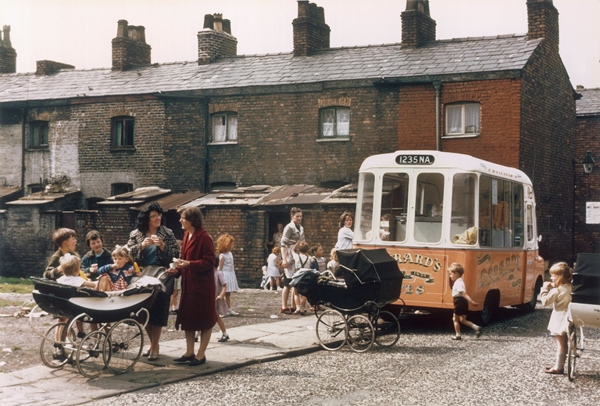
'Ice Cream Van on Terraced Street', July 1965, photography by Shirley Baker, via The Guardian

Nowadays, as contribution to the nation's wealth has been robbed from these people, these former workers' wards/ districts have become wards/ districts of passive - i.e. unproductive - consumerism. This model is replicated throughout our Western societies and this passive consumerism, detached from production and purpose, is the sign of a fractured society. Because having a purpose in life drives you. Having no purpose other than wait for the cheque from the social, while the world is passing you by, is no driver in itself.
 
Meanwhile Shirley's photographic legacy reminds us that there are no rose-tinted ways of viewing poverty, only compassion, through the respectful, non-intrusive intimacy which her eye and lens share with her subjects. It is a social documentary with a heart, the photographic labour of love about a labour force caught in the midst of times achanging.

Looking Back to Look Forward should have been a motto for Council chiefs, private sector entrepreneurs and their acolytes to apply to Manchester for its successful transition into the future, while taking into account the best elements from the past (including values) and the expectations of four generations of the population (from cradle to the grave, if you pardon me the phrase), with the design fitting their lives rather than the other way around. I believe in integrated sensible redevelopment, based on brand-new builds based on classical design, and renovations of designated buildings. I do not believe that redevelopment should require the utter obliteration of the wards.

Further Resources:

Further Reading List - about today's working poor in Britain:
 
Further Manchester Photography: 
The Manchester City Council website is an excellent starting point. The following two resources it lists will provide subsequent photographic information and much more:-